

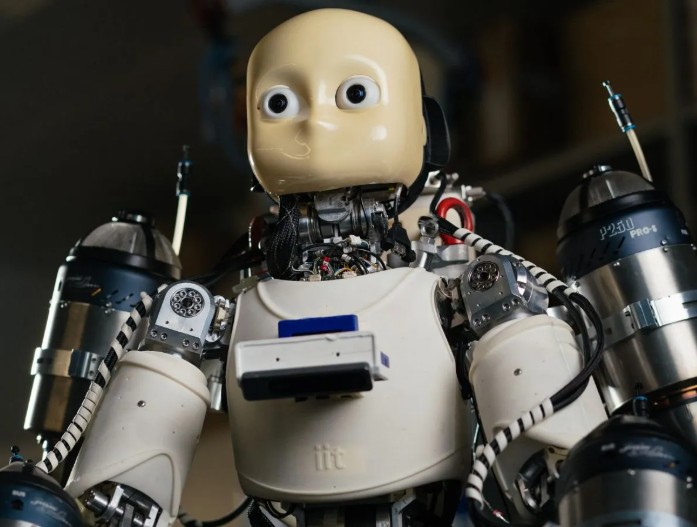
Researchers at the Italian Institute of Technology (IIT) have made a major leap in humanoid robotics by getting their iRonCub3 prototype to take flight, albeit briefly. What began as a 2004 kid-sized “iCub” platform has evolved into a jet-propelled machine that, earlier this summer, rose about 50 centimeters off the ground and hovered stably for a few seconds. The accomplishment marks one of the first times a full humanoid robot has lifted off under its own power using jet thrust, tells IEEE Spectrum.
The vision behind iRonCub is ambitious. In disaster zones, such as floods, fires, or collapsed buildings, the robot could fly over debris, land, then switch to walking mode to interact, move obstacles, open doors, or assist survivors. To do this, the design packs four jet engines distributed across its back and arms, delivering over 1,000 newtons of thrust. But translating that power into controlled flight is challenging: the robot must actively shift engine orientation using its limbs to maintain balance.
These jets spit gas at nearly supersonic speed and temperatures around 800°C, pushing the boundaries of materials and thermal dynamics. As it flies, the robot also contends with aerodynamic forces on its body, something humanoid robots seldom confront. To address this, the IIT team recently published a paper modeling aerodynamic effects in humanoids using a mix of classical control and learning techniques.
Though the flying robot catches imaginations, the team is pragmatic about next steps. They plan to add more control degrees (such as yaw control) and possibly wings for efficient long-distance flight. Future tests may require access to airport airspace, beyond the rooftop test stand that currently hosts experiments.
Even if full flying humanoids remain futuristic, the research is already paying off. The control algorithms developed for thrust estimation and aerodynamic compensation are relevant to eVTOL craft and other robotics systems. And from an educational standpoint, iRonCub is an inspiration: its daring goal helps attract talent and keeps researchers pushing boundaries.
