

I get together with Maor for the second time on a Zoom call. It’s 8 am my time. It is 6 pm in Israel, where Maor lives. But Maor is just getting started. He will be talking to customers until 10 pm, then going home to be a Dad. He has a two-month-old daughter now, which is why our call was delayed two months. That’s okay. I preach, if not practice, a family-first doctrine.
Gotta say, Maor looks fresh as a daisy after already putting in what would be for the rest of us, a full day. This may be why he gets so much done. The bio I am making for Maor’s podcast episode is already a mile long. It might be the whole episode. He most recently founded Leo AI, along with classmate, neighbor and close friend, Moti Moravia. Leo AI is perhaps the most advanced use of AI in CAD I have seen. He’s managed to round up investment. He was the youngest PhD at Israel’s Technion. He was a Fulbright scholar and did post-doctoral work at MIT. He founded Learn to Succeed and wrote a book of the same name to motivate poor Israeli youth. He was named in Forbes’ 30 under 30 in 2019. He’s served in his country’s version of the NSA. Only 33 years old, Maor, he already has a Wikipedia page. Despite his accomplishments, he is charming, gracious and forgiving of dumb questions (thank God) — while still keeping a laser focus on the mission, which is nothing less than making AI truly useful for mechanical design.
From War Zone to Workstation
Maor’s story starts not in a Silicon Valley startup incubator but in northern Israel in July 2006. “We were on vacation when the Israel–Lebanon war broke out. Bombs were falling. I realized then that technology was the only way forward — to protect our homes, our families,” he recalls. That moment made him realize he had to become a mechanical engineer.
In high school, by chance, he stumbled onto SolidWorks. “The moment I touched the mouse, I was hooked,” he says. That chance encounter set him on the path through a bachelor’s, master’s, PhD, and a postdoc in mechanical engineering — all fueled by a belief in technology’s ability to protect and improve lives.
Early Disillusionment
Maor’s dream of being an engineer almost did not survive his first engineering job.
“The worst days of my life,” he says of his first months on the job. “Instead of innovating, I was a glorified secretary, searching PDFs and vendor catalogs for bolts and bearings that didn’t even fit”.
It wasn’t just him. He cites staggering attrition rates from Israel’s elite Brakim engineering program: 80% of its graduates left mechanical engineering altogether. “These were the smartest people in the country,” Maor says. “They dreamed of building robots. Instead, they were stuck pushing paper.”
That gap between the promise of engineering and the drudgery of reality would eventually inspire Leo AI.
Why CAD Was Never “Computer-Aided”
Maor is blunt in his assessment of the industry he aims to upend. “CAD is not design. CAD is not mechanical engineering. CAD was never computer-aided. It’s computer-represented geometry,” he says.
What he means is that design still happens in the engineer’s mind. CAD tools are glorified documentation systems, suitable for representing geometry but not for aiding the decision-making process. “Topology optimization? It doesn’t give good shapes. It’s not smart. It’s not intelligence,” he adds.
Leo AI, by contrast, aims to free engineers from the 80% of their workday spent on paperwork, information retrieval, and bureaucratic tasks, so they can focus on the 20% they actually love — building and designing.
The Five Beers
Does Leo threaten to replace engineers?
“God forbid. It’s quite the opposite,” says Maor. “We want every mechanical engineer to focus on what they love and do best, which is build beautiful, fantastic products”.
He knows first-hand how fragile trust in AI can be. Maor is a fan of The Five Whys and has adapted it to The Five Beers. Many engineers he spoke with were skeptical, even fearful. “After four beers, they’d admit they were afraid of AI,” he says. “But after the fifth beer, the truth came out: they didn’t trust it.”
That’s why trust has become Leo AI’s North Star. “Some of our customers say, ‘Leo is the only AI I can trust.’ That’s what we want to maximize,” he says.
How Leo Works
So what does Leo AI actually do? At its core, Leo plugs into a company’s existing knowledge base — CAD files, PLM systems, engineering documents, standards — and becomes a kind of hyper-experienced coworker who never forgets.
“Imagine you need a spring,” Maor says. “You tell Leo the parameters. If you miss some, it runs the calculations for you, checks your standards, and recommends the best fit. It’s like having the smartest engineer in the company sitting on your shoulder.”
If not the smartest, at least the best read and with the best memory, I think.
That ability to digest not just text but geometry is what sets Leo apart from large language models. “Language models are bounded by language. They’ll never catch that there’s a hole in your design. Leo understands CAD. That’s our proprietary breakthrough,” he explains.
Engineers as Decision-Makers
Maor emphasizes that Leo is not about churning out full products. “We don’t want to design a whole robot for you. That’s not how engineers work,” he says.
It’s not how engineers want AI to work, either. Instead, Leo operates at the level of assemblies and subsystems — the same level an engineer would delegate to a trusted assistant, maybe a junior engineer.
“Engineers are in the decision-making business,” he says. “Leo gives you the data, the parts, the comparisons. You stay in control”.
It’s a philosophy engineers can get behind. All engineers need help. No engineers want AI to run away and spit out a design. An aircraft designed by AI is not an aircraft we would fly in. But if AI wants to help us with the design of the plane, that’s another story.
Or a vehicle. For example, can we say at some point “Hey, AI. Help me electrify this car?”
Leo is not able to handle electrifying a car — mot yet, but design assistance of that level is indeed where it appears to be heading.
Adoption and Momentum
Launched in May 2023, Leo has already attracted more than 55,000 users — without spending a dollar on marketing. Customers range from HP to Intel Mobileye to defense contractors. But the testimonials mean more to Maor than the logos.
“One aerospace engineer told us that with Leo, he designed a system in one and a half hours that used to take three engineers three weeks,” Maor says.
The Bigger Mission
Despite dreamy goals of an AI-assisted future, Maor insists he’s not a starry-eyed futurist. He’s allergic to AI hype. It’s not AI, but “IA — intelligence augmentation” he is after. “Find a real use case. Solve a real problem. Don’t sprinkle AI fairy dust”.
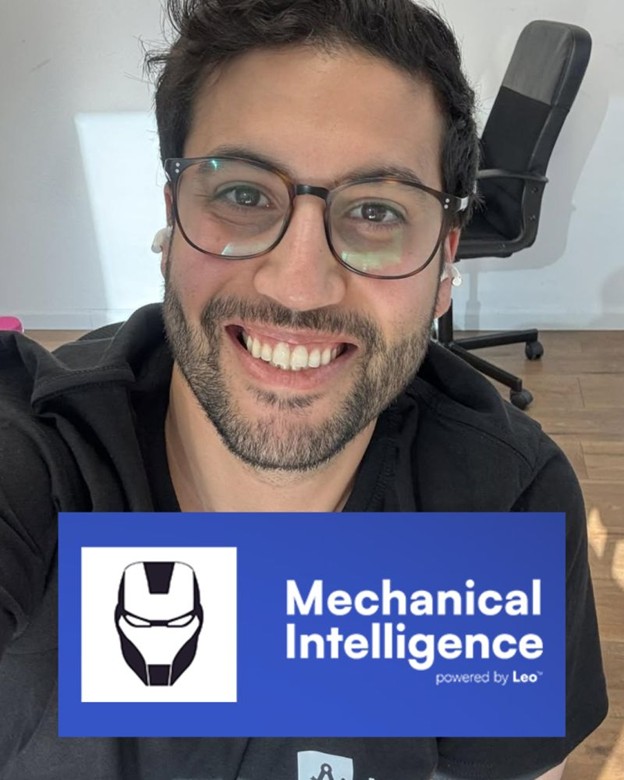
That pragmatic mindset has led him to create not just a company but a community. He recently launched the Mechanical Intelligence Community, the first global network focused on AI for engineers. “One rule: no BS. Only real tools, real studies, real results, by and for mechanical engineers,” he says.
The Future of Design?
Is Maor Farid the face of the future of design software? He certainly looks and acts the part. He combines an academic pedigree and real-world experience with a startup’s conviction that a revolution needs to happen and they can lead it, his conviction being that 50-year-old CAD technology can still finally live up to its promise of designs being computer-aided.
Good luck, Maor. Engineers the world over are rooting for you.
