

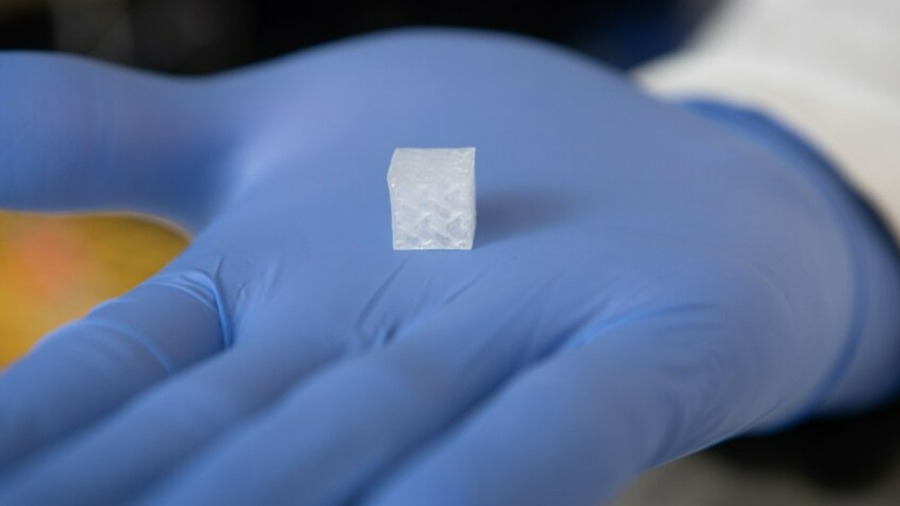
Credit: Wake Forest Institute for Regenerative Medicine
CAPE CANAVERAL, FL, Aug 21, 2025 – Researchers from the Wake Forest Institute for Regenerative Medicine (WFIRM) is sending 3D bio-printed liver tissue with vascular channels to the International Space Station to study how microgravity affects tissue growth. The NASA-sponsored project, sponsored by the ISS National Laboratory, is set to launch on SpaceX’s 33rd commercial resupply services mission.
Bioprinting enables researchers to build 3D structures from living human cells, creating models of human tissues and organs. These lab-grown tissues help scientists study diseases or repair damage caused by illness, injury or aging. The liver, known for its complex blood vessel networks, is a current research focus. WFIRM scientists have developed liver tissue constructs with blood channels that last up to 30 days in labs on Earth. However, on Earth, growing large, thick tissues is difficult because it is challenging to build enough blood vessels to function. Without vascularization, tissues cannot deliver oxygen or nutrients or remove metabolic waste, causing them to lose function over time.
Microgravity may cause changes in cell distribution, behavior, and adherence properties. These changes could provide insight into how to manufacture longer-lasting tissues for disease research and treating patients on Earth.
The experiment will test whether microgravity changes how cells grow, potentially improving tissue formation and development. Researchers will use Redwire Space’s Multi-Use Variable-Gravity Platform (MVP) facility for this work. James Yoo, a professor at WFIRM leading the study, said the experiment’s results could improve tissue engineering on Earth and inform future efforts to grow transplantable tissue and organs in space.
“This collaborative investigation has the potential to yield remarkable results,” said Yoo. “By leveraging bioprinting technologies, we’ve created gel-like frameworks with channels for oxygen and nutrient flow that mimic natural blood vessels, opening up new possibilities for medical treatments both on Earth and in space.”
Two teams of researchers and students from WFIRM – Team Winston and Team WFIRM – used 3D printing technologies to create their tissue constructs as part of NASA’s Vascular Tissue Challenge, a prize competition aimed at accelerating tissue engineering innovations to benefit space exploration and people on Earth by improving regenerative medicine technologies. The teams won prizes totaling $400,000 in research funding as a result of their technology demonstration on Earth, and both teams will have the opportunity to test their innovations on the space station. Team Winston will be the first team to take their innovation to space.
For this study, Team Winston will evaluate how liver and vascular cells develop and function in the construct under microgravity, For example, the team will examine if vascular cells form proper linings in the liver construct’s blood vessel walls.
The Vascular Tissue Challenge is part of NASA’s Centennial Challenges program in the space technology mission directorate. The Methuselah Foundation’s New Organ Alliance organized the competition for NASA and assembled a nine-member judging panel focused on regenerative medicine research with support from NASA, the National Institute of Health, the ISS National Lab, and academic researchers.
“Our mission at the Methuselah Foundation involves advancing human longevity through regenerative medicine,” said David Gobel, co-founder and chief executive officer of the Methuselah Foundation. “By collaborating with NASA and the ISS National Lab to accelerate innovation, we’re not only improving human health on Earth but also preparing for the challenges of space exploration and bolstering the future space industry.”
The mission is targeted for launch from Cape Canaveral Space Force Station no earlier than August 24, 2025, at 2:45 a.m. EDT and will include more than 20 ISS national lab-sponsored payloads.
Source: ISS
About the International Space Station (ISS) National Laboratory

The International Space Station is an orbiting laboratory that enables research and technology development not possible on Earth. Operated as a public service, the ISS National Laboratory allows U.S. government agencies, academic institutions, and private-sector organizations to access its microgravity environment, Earth observation capabilities, and space-based conditions to support non-NASA science, technology, and education initiatives. The lab promotes research aimed at improving life on Earth, supporting the growth of commercial space activity, and advancing STEM education. Established in 2005, the ISS National Laboratory has been managed by the nonprofit Center for the Advancement of Science in Space (CASIS), since 2011 under a cooperative agreement with NASA. Headquartered in Rockledge, FL, the lab has supported more than 700 research payloads. In fiscal year 2024, it sponsored over 100 experiments, nearly 80% from commercial users. That year, funding commitments totaled nearly $25M, with STEM outreach and over 50 publications.
