


CAMBRIDGE, MA, Feb 13, 2026 – JuliaHub has launched Dyad AI, an agentic engineering framework built for real-world physics. Dyad AI targets product development that depends on validated physical behavior. Dyad AI provides an AI for Science environment where agents build and test engineering models. Agents can derive governing equations, assemble models, run high-fidelity simulations, and check physical consistency at each step. Engineers stay in control, while agents run the workflow end to end.
“Dyad operates at the level of engineering, not code,” said Dr. Viral Shah, CEO and co-founder of JuliaHub. “Most agentic tools stop at producing syntax. Dyad AI engages equations, constraints, and physical laws, integrating simulation, parameterization, performance testing, and automated calibration so agents can co-design systems grounded in real physics. This is where AI for Science is moving, AI collaborating with engineers on models, behavior, and validation to close the loop between intent and verified performance.”
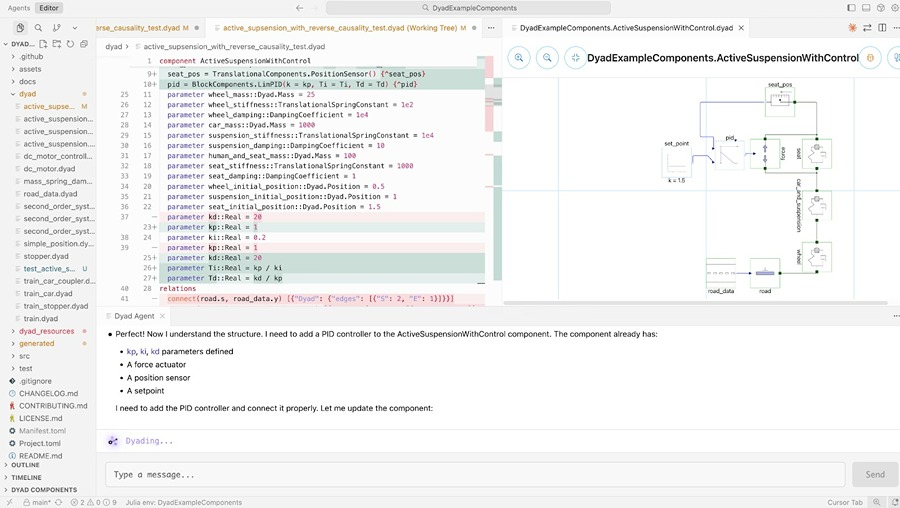
Dyad AI unifies the language, compiler, and simulation engine in one environment. The company said the generate, simulate, validate, refine loop runs inside the platform, so agents can test, correct, and improve designs.
The Need for Agentic Hardware Intelligence
Many coding assistants can generate syntax. Engineering teams also need agents that reason over physical systems. That includes equations, constraints, and physical laws.
JuliaHub said teams must be able to:
- Derive governing equations and verify physical coherence
- Model coupled, multi-physics behavior
- Validate units, energy balance, and boundary conditions
- Iterate until the solution satisfies physical constraints
Agentic AI for Engineering Workflows
Dyad AI enables agents to complete engineering tasks end to end. Engineers provide direction, and agents execute modeling and simulation work.
Dyad AI agents can:
- Research formulations and governing equations
- Assemble components into physical systems
- Generate, run, and interpret simulations
- Calibrate and tune parameters
- Validate behavior against physical laws
- Justify reasoning behind every decision
This workflow keeps modeling, simulation, analysis, and code generation in one environment. JuliaHub said it designed Dyad AI for physics-grounded engineering loops.
Correct by Construction
Dyad AI includes safeguards to catch physics errors during modeling and simulation. It also produces executable, traceable documentation.
JuliaHub said safeguards include:
- Unit and dimensional analysis
- Type-safe physical connections
- Multi-domain validation
- Energy and mass-flow consistency checks
- Executable, traceable documentation
Engineering complexity is rising while development cycles are shrinking. Older tools cannot support agentic workflows without changes.
JuliaHub listed the following targets for Dyad AI:
- 10x productivity improvements
- 100x faster simulation and analysis
- Lower development costs
- Greater innovation
- Accelerated development cycles
Dyad AI lets agents handle formulation, simulation, and early validation. The environment supports AI-native product development by keeping testing and design refinement in one loop. Agents can test designs, explain their reasoning, and improve models inside a physics-aware workflow.
Source: JuliaHub
About JuliaHub

JuliaHub, founded in 2015 and headquartered in Cambridge, MA, provides cloud software and tools for scientific and technical computing. The company supports pharmaceutical, aerospace, automotive, electronics and manufacturing customers that use modeling, simulation and computational analysis in their research and engineering work. JuliaHub develops and maintains a platform for building and running applications in the Julia programming language and offers tools for Scientific Machine Learning, digital-twin modeling, circuit simulation and drug-development workflows. The company reports more than 10,000 global users and employs about 110 people worldwide. Its stated mission is to support organizations addressing scientific and engineering problems by delivering secure computing environments and mathematical and machine-learning capabilities.
