


CAMBRIDGE, MA, Nov 24, 2025 – JuliaHub and Synopsys have partnered to connect the Dyad modeling platform with Ansys TwinAI, creating a shared workflow for physics-based simulation and digital-twin development. The integration links Dyad’s AI-driven modeling tools with Synopsys’ system-level twin technology to support hardware design, testing and performance analysis.
TwinAI empowers organizations to operate digital twins in cloud environments that support simulation engines, operating systems, and data streams. The platform offers capabilities to simulate digital twins, enhance model accuracy using Hybrid Analytics, and simplify cloud deployment.
Through the integration of Dyad, TwinAI will link physics-based simulation with adaptive AI models, giving engineers digital twins that predict system behavior while remaining grounded in physical laws.
“A digital twin is more than a model. It’s a living, dynamic representation of a system,” said Dr. Prith Banerjee, senior vice president, Synopsys. “By integrating Dyad and JuliaHub’s SciML technology, TwinAI empowers engineers to build digital twins that evolve with data, bridging the gap between simulation and reality.”
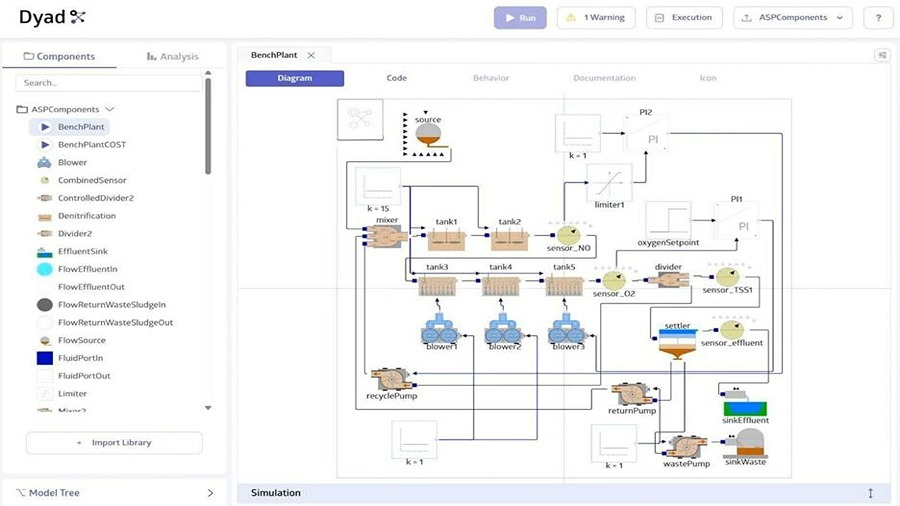
Dyad uses component-based modeling and automatic equation generation to help engineers build and modify complex systems across multiple domains. When combined with Ansys simulation tools, the integration supports real-time system analysis, data-driven predictions, and cloud-based digital twin deployment.
“This partnership brings JuliaHub’s scientific machine learning innovation to one of the world’s most trusted simulation ecosystems,” said Viral B. Shah, CEO and co-founder of JuliaHub. “Together, we’re enabling the next generation of intelligent digital twins which is adaptive, explainable, and deeply rooted in physics.”
Source: Juliahub
About Synopsys

Synopsys Inc., founded in 1986 and based in Sunnyvale, CA, provides software and intellectual property for semiconductor design and verification. Its tools support the full chip development process, including electronic design automation, simulation, silicon IP, and software security testing. The company serves a range of industries, including semiconductors, automotive, aerospace, defense, data centers and industrial systems. Synopsys employs more than 20,000 people worldwide. Its technology is used by chipmakers and system developers to accelerate innovation in areas such as AI and advanced computing.
About JuliaHub

JuliaHub, founded in 2015 and headquartered in Cambridge, MA, provides cloud software and tools for scientific and technical computing. The company supports pharmaceutical, aerospace, automotive, electronics and manufacturing customers that use modeling, simulation and computational analysis in their research and engineering work. JuliaHub develops and maintains a platform for building and running applications in the Julia programming language and offers tools for Scientific Machine Learning, digital-twin modeling, circuit simulation and drug-development workflows. The company reports more than 10,000 global users and employs about 110 people worldwide. Its stated mission is to support organizations addressing scientific and engineering problems by delivering secure computing environments and mathematical and machine-learning capabilities.
About Dyad
Dyad, introduced in 2025 and developed by JuliaHub in Cambridge, MA, is a modeling and simulation product that supports engineering teams working on hardware design, aerospace, automotive, manufacturing and embedded systems. The platform offers a visual interface and a code-based environment that let users build physics-based models using diagrams or text. It supports engineering workflows that require model calibration, system testing and generation of embedded or safety-certified code. Dyad combines cloud-based infrastructure, differentiable programming and modular components to support work on digital models that evolve with real-world data. It also incorporates scientific machine learning to refine models, identify missing physical behaviors and create updated code. The system supports use cases such as predictive maintenance, real-time performance tuning and remote updates while keeping engineers involved in each step. Dyad serves corporate engineering, research and development teams rather than general consumers.
