

Plans to establish long-term human settlements on the Moon depend heavily on the ability to build structures using local materials rather than transporting everything from Earth. Engineers are therefore investigating technologies that can transform lunar soil, known as regolith, into construction materials. A recent study highlighted in IEEE Spectrum proposes a laser-based additive manufacturing method that could convert lunar rocks into solid building blocks suitable for future Moon bases.
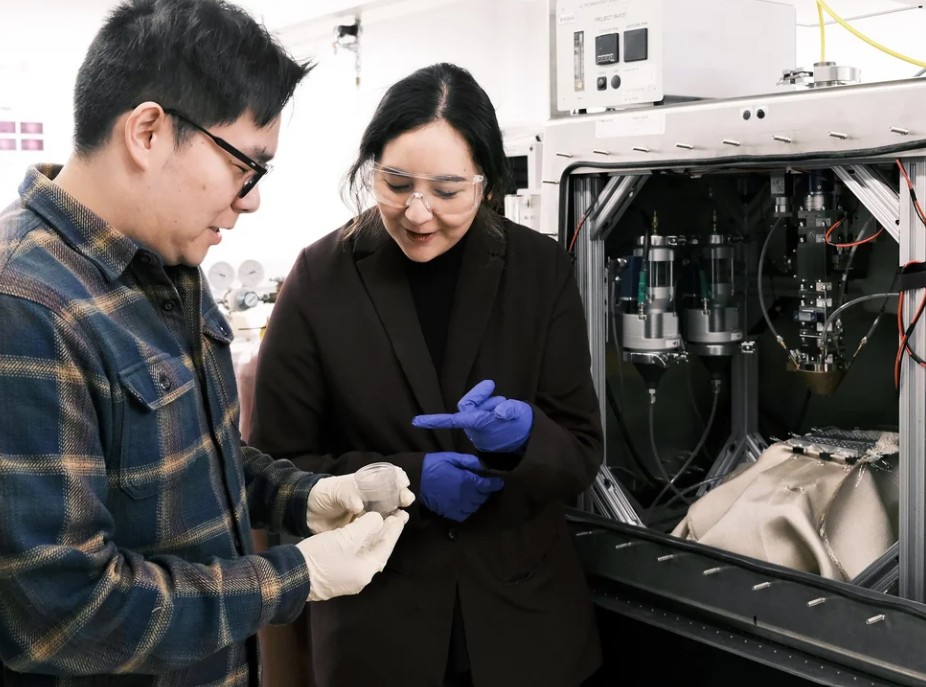
The research, led by scientists at The Ohio State University, focuses on a process called laser-directed energy deposition. In this approach, powerful lasers melt simulated lunar regolith and fuse it layer by layer into solid structures. The method resembles industrial metal 3D printing, but instead of powdered metals, it uses regolith simulants designed to replicate the composition of lunar surface materials. The researchers worked with Lunar Highlands Simulant (LHS-1), a basalt-rich material similar to rock samples collected during the Apollo missions.
Tests showed that the melted regolith could be fused onto surfaces such as stainless steel or glass to form stable structures. Researchers discovered that the quality and strength of the printed material depended strongly on the base surface used during fabrication. When the regolith bonded with alumina-silicate ceramics, the interaction produced crystalline structures that improved heat resistance and mechanical strength.
Developing such technologies is crucial for in situ resource utilization, a strategy aimed at making lunar bases more self-sufficient. Transporting building materials from Earth is expensive and logistically difficult, especially for missions intended to last months or years. By printing tools, infrastructure, and habitat components directly from local resources, astronauts could significantly reduce dependence on supply missions.
However, many challenges remain before the method can operate on the Moon. Engineers must account for the lunar environment, which includes vacuum conditions, extreme temperature swings, and abrasive dust particles. The researchers also suggest that future large-scale systems might rely on solar or hybrid power sources instead of conventional electrical systems.
If these challenges can be overcome, laser-based 3D printing could become a key technology for constructing resilient infrastructure on the Moon and supporting long-duration human exploration missions.
