

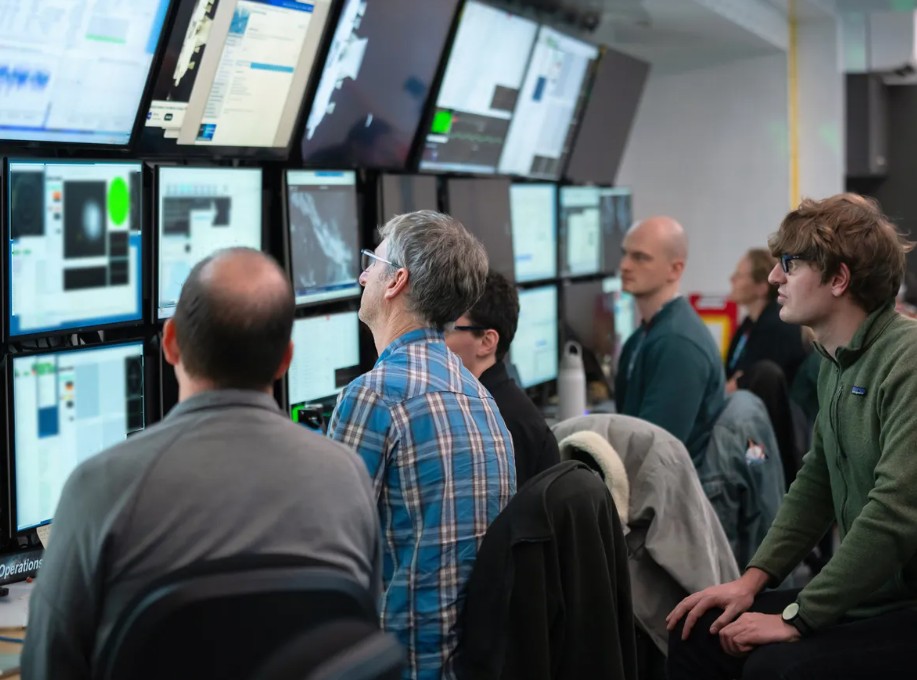
NASA’s Artemis program is helping push free-space optical communication from experimental research into operational space infrastructure. The IEEE Spectrum article examines the growing importance of laser-based communications for future lunar and deep-space missions, where traditional radio systems are increasingly constrained by bandwidth limitations and rising data demands.
Unlike conventional radio-frequency communication, free-space optical communication uses tightly focused infrared laser beams to transmit information across space. Because laser wavelengths are much shorter than radio waves, they can carry substantially larger amounts of data while using smaller and lighter onboard equipment. For missions expected to generate high-resolution imagery, scientific measurements, video streams, and continuous telemetry, this increase in capacity is becoming essential.
The article highlights recent Artemis-related demonstrations involving NASA’s Orion spacecraft and optical ground stations on Earth. Engineers successfully transmitted high-speed laser communications between Orion and observatories on the ground, achieving data rates fast enough to support ultra-high-definition video transmission from lunar distances. These demonstrations represent a major step toward building stable communication networks for long-duration human exploration beyond Earth orbit.
A central theme of the article is efficiency. Optical systems reduce spacecraft size, weight, and power requirements compared with large radio antennas. This is particularly important for lunar and Mars missions, where payload mass directly affects mission cost and spacecraft design. Smaller communication systems also create opportunities for more compact satellites, autonomous probes, and distributed exploration architectures.
The article also explains the engineering challenges involved in maintaining optical communication links across vast distances. Laser beams require extremely precise alignment between spacecraft and ground receivers. Atmospheric interference from clouds, turbulence, and weather can disrupt transmissions, forcing engineers to develop adaptive optics systems and geographically distributed receiving stations capable of maintaining stable connections under changing conditions.
Researchers view optical communication not simply as an upgrade to existing systems but as a foundational technology for future exploration. As missions move farther into deep space and generate exponentially larger datasets, conventional radio infrastructure may no longer provide sufficient capacity. Artemis is therefore serving as both a lunar exploration initiative and a proving ground for a new generation of high-speed space networking technologies that could support sustained human and robotic activity throughout the solar system.
