

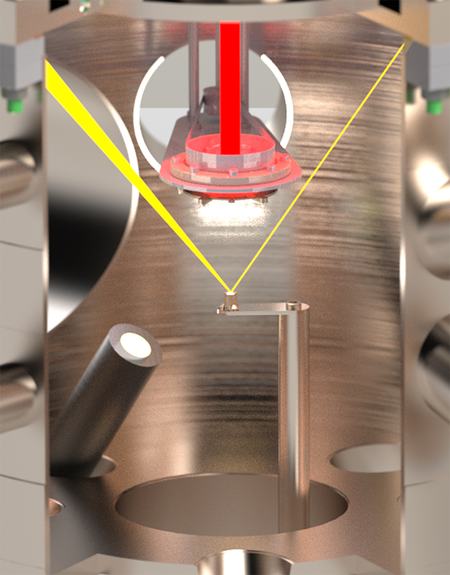
A major hurdle in advancing quantum technologies lies in fabricating materials that can operate under extreme physical conditions. Many of these materials, particularly those used in superconducting electronics, require thin-film form but are difficult to produce due to their extraordinarily high melting points. Conventional techniques rely on heating materials until they vaporize, but some “ultra-refractory” elements require temperatures above 3,000 Kelvin, making them nearly impossible to handle with standard equipment.
Researchers at Caltech have developed a laser-based synthesis method that bypasses this limitation. Instead of heating an entire material uniformly, the technique focuses a high-power laser on a small region of a solid pellet. This localized heating melts only a tiny pellet of the material, generating vapor that rises and deposits onto a substrate to form a thin film. Crucially, the rest of the pellet remains solid, effectively acting as its own containment system and eliminating the need for extreme-temperature vessels.
This approach opens the door to producing thin films of materials that were previously inaccessible, including niobium and other compounds critical for quantum devices. Thin films are essential in electronics because they enable precise control over material properties at the nanoscale, allowing phenomena such as superconductivity and quantum coherence to emerge in practical systems.
Beyond enabling new materials, the technique represents a broader shift in materials science. By using advanced laser systems originally developed for industrial cutting and welding, researchers can now recreate extreme thermodynamic conditions in a controlled laboratory setting. This capability expands the range of materials that can be synthesized and studied.
The implications extend directly to quantum computing and next-generation electronics. As devices increasingly rely on specialized materials with precise atomic structures, methods like this laser-driven process could accelerate discovery and fabrication. What was once a fundamental limitation in materials synthesis is now becoming a solvable engineering problem, bringing practical quantum technologies closer to reality.
