

Offshoring was the default playbook for American manufacturers. Until it wasn’t. You can blame any or all of the following reasons: the pandemic, rising costs of labor overseas, trade wars or geopolitics, but whatever you blame, the way forward will require a different playbook.
Offshoring was fine when we had free global trade, cheap container shipping and a world not convulsing with COVID. That era has ended. The pandemic exposed just how vulnerable we were to supply chains that were stretched out from one side of the world to the other. Along the way, pirates that hijacked container ships and held them and the crew for ransom and canals too narrow for the extreme lengths of these massive ships. Now we have trade wars and tariffs.

Container ships passing through the Suez Canal, Egypt. Cargo ships loaded with containers provide economies of scale; the cost of shipping a container has risen dramatically and can be as high as $8,500. Stock photo.
Offshoring also required more time. While design and engineering data can be conveyed overseas at the speed of data, manufactured goods arrive on a literal slow boat from China.
Offshore wages have climbed, as have freight costs. As countries prosper from manufacturing, their worker wages invariably increase.
Offshoring also incurs numerous unforeseen costs. We experience delays, rework, and production emergencies that may require overseas travel. Adding all this up, many companies have found that the economic advantage of offshoring has all but disappeared.
The old formula—offshore to save on labor—no longer equates to the same payoff.
Bringing Manufacturing Back
It’s tempting to imagine onshoring, the alternative to offshoring, as a matter of simply reopening old factories and picking up where we left off. However, according to “Why Smart Factories Are the Only Path to Successful Onshoring,” a white paper commissioned by First Resonance, that idea is a myth.
First of all, factories left behind in the offshoring era were designed for a different world, one that could deliver the benefits of mass production and standardization. Turning on the lights and powering up the machines in those shuttered factories would only recreate the problems that led to offshoring in the first place, including high local labor costs and process and system inefficiencies.
Even if a factory remained intact — a big “if” considering decades of neglect — good luck finding labor. Over the course of decades of manufacturing going overseas, the factory labor force has all but vanished. Training programs vanished, too. Workers retired. Their sons showed little interest in following in their footsteps, their daughters even less.
During the era of offshoring, the products manufactured and assembled have undergone significant changes, particularly in sectors such as electronics, aerospace, and automotive. All have become a sophisticated mix of electronics, computers and plastics. They can be manufactured in low volume and some are even customizable.
The factory equipment of old was not built for this.
Reinventing, Not Just Relocating
If onshoring is the destination, smart factories are the vehicle that makes it possible to get there. Simply moving production back to U.S. soil won’t solve the challenges of cost and labor shortages. The future belongs to manufacturers who rebuild their operations from the ground up, and smart factories are the blueprint for that success.
Smart factories utilize the latest technologies, including automation, AI, digital twins, low-code development, industrial IoT, connected devices, collaborative robots (cobots), and AR (augmented reality), to offset the higher labor costs in the U.S. The technologies collectively, when implemented effectively, allow smaller teams to supervise multiple lines and focus on high throughput. They can troubleshoot, adapt, and optimize processes themselves. They can digitize tribal knowledge, build efficient workflows and drive continuous improvement.
Unified factory control systems, if present, could be brittle giants, cracking with machine or version updates. In fact, updating the software that controlled the entire factory was so labor-intensive and prone to numerous problems that it was often avoided for as long as possible, leaving the factory vulnerable to dual threats: falling behind the competition by not running the latest software and cyberattacks.
“Smart factories aren’t retrofits—they’re reboots.”
Smart factories, on the other hand, are modular and API-driven, with their parts more easily integrated to form a whole. Manufacturers can incorporate new analytics tools, deploy predictive maintenance microservices, or upgrade machine interfaces without disrupting the entire operation.
Time is of the Essence
When getting a product to market, speed is of the essence. If your company is racing to keep up with the competition, speed could mean the difference between survival and failure. A smart factory may be the most critical factor in the whole concept-to-market chain.
In a traditional offshore model, a design change can be implemented overseas quickly; however, the manufactured product may take weeks, or even longer, due to factors such as pandemics, piracy, canal congestion, or other delays.
A smart factory, on the other hand, is only a truck ride away.
Time can be saved right on the shop floor, as well. Smart factories don’t just collect data—they act on it. Industrial IoT sensors, machine learning algorithms, and digital twins create a closed-loop system where every production run yields insights:
- In machining operations, AI can continuously adjust parameters such as cutting speed and feed rate to achieve optimal yield.
- Anomalies in factory equipment can be detected quickly and even anticipated.
- Operators receive AR-guided instructions for immediate troubleshooting.
“Geographic proximity doesn’t just save shipping time—it eliminates confusion.”
Planning and coordination are more efficient when a factory is smart and nearby. When engineers, operators, and quality teams work in the same environment, there’s no friction from language barriers, time differences, or data mismatches. Everyone has easy access to the same data and shares the same objectives.
Alignment comes more easily, decisions can be made faster, and with greater confidence.
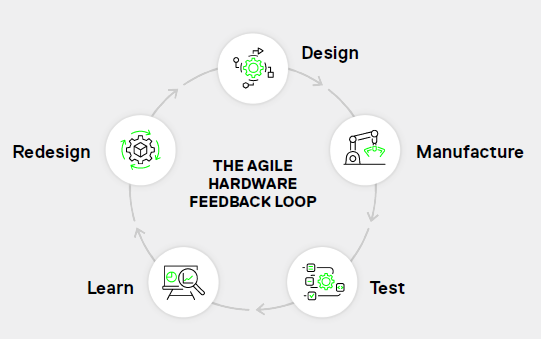
Agile manufacturing loops can also save time. Similar to agile software development, agile manufacturing loops are composed of:
- Design
- Manufacture
- Test
- Learn
- Redesign
Design iterations can take place in days instead of months.
How Governments Are Helping Make Onshoring Work
The United States, through public policy and government investment, is stepping up to bring manufacturing home. As “Why Smart Factories Are the Only Path to Successful Onshoring” explains, a convergence of incentives, funding, and strategic support has become the catalyst for successful onshoring.
U.S. policies have injected billions of dollars into the domestic manufacturing ecosystem. The CHIPS and Science Act alone includes over $50 billion to rebuild America’s semiconductor capacity, funding everything from advanced research and development to new fabrication plants. In the fast-paced world of the electronics industry, speed and proximity are paramount.
The Inflation Reduction Act and the Bipartisan Infrastructure Law, passed under the previous administration, would also help with onshoring by funding the production of clean technologies, such as batteries, electric vehicles, and renewable energy components. These policies were intended to create a new demand for domestic manufacturing, although much of that towering bill has encountered some speed bumps under the present administration.
Beyond funding, governments are tackling one of the most persistent challenges in American industry: the skills gap. Over the course of decades of offshoring, much of the domestic expertise in manufacturing has been lost. Today, agencies such as the National Institute of Standards and Technology (NIST), MxD (Manufacturing Digital), and CESMII are stepping in to rebuild that capability. They’re funding vocational training and filling workforce pipelines that combine manufacturing skills with digital fluency, ensuring the workforce needed for smart factories is available to operate, program and improve smart systems.
Policymakers are also working to ensure that technology investments are future-proof. Instead of encouraging companies to build silos of proprietary data, new standards focus on sharing data and interoperability, allowing factories to update and upgrade software without extensive system overhauls.
These efforts are already driving measurable results. In 2022 alone, more than 360,000 U.S. manufacturing jobs were announced through reshoring and foreign direct investment—a 53% increase over the prior year.
Public policy goes beyond creating incentives to bring manufacturing back. It establishes the ecosystem that smart factories need to be sustainable, combining funding, standards, infrastructure, and talent development.
From Data Overload to Action
Not long ago, the mantra in manufacturing was simple: collect more data. “Data is the new oil,” experts declared, and factories dutifully embedded sensors into every machine, line, and process. The result? An unprecedented flood of information—temperature readings, vibration signatures, cycle times and much, much more—streaming around the clock.
But data alone doesn’t drive performance. Many early Industry 4.0 efforts focused on the production and presentation of data. Factories ended up with dashboards full of metrics. But what was missing? Control.
“A factory with real-time metrics but no operator empowerment is like a cockpit with gauges but no controls.”
This is where AI and smart-factory platforms, such as ION, change the equation. Rather than treating data as an end in itself, AI systems employ advanced techniques—such as regression analysis and neural networks—to sift through the noise, detect patterns, and generate recommendations in real-time.
In a smart factory environment, AI can:
- Continuously analyze sensor streams for subtle anomalies—tiny deviations in vibration or temperature that signal emerging problems.
- Predict when a machine will require maintenance before it fails, reducing downtime and avoiding unplanned costs.
- Automatically adjust process parameters such as feed rate, cutting speed, or temperature setpoints to optimize yield and quality.
ION, described by First Resonance as a modern factory operating system, takes this a step further by integrating low-code tools and digital workflows. That means frontline teams aren’t just passive recipients of AI insights; they can build and customize how those insights get applied.
For example:
- Engineers can create custom supply chain rules or quality checks without writing traditional code.
- Operators can use mobile devices or augmented reality overlays to view AI recommendations directly within their workflow.
- Supervisors can automate responses to recurring issues, turning tribal knowledge into scalable processes.
This human-machine partnership is the heart of modern smart factories: AI handles the scale and complexity of data, leaving people with bandwidth to provide context, judgment, and creativity. The result isn’t just better visibility of data—it’s a factory that can adapt on its own, continuously improving performance.
The promise of data isn’t in collecting more of it—it’s in acting faster and smarter.
Turning Data Into Action
Data by itself doesn’t transform a factory. What makes data powerful is the ability to act on it quickly and effectively. Instead of waiting weeks for IT teams or expensive software consultants to build custom solutions, a digitally trained modern factory employee can use low code to create the solutions.
Low-code is a method for creating applications, workflows, and automation rules that eliminates the need for traditional software code. Instead of relying on developers, engineers and frontline teams can drag and drop logic blocks, connect data sources through visual editors, and design workflows themselves.
Low-code solutions are developed by those who know smart factories best —the workers, who can, in effect, pour their tribal knowledge into these solutions. Once in the system, they can be scaled up, making tribal knowledge accessible to everyone at once and shareable by all, including new factory workers.
Take, for example, a satellite manufacturer. Engineers can use low-code to define custom production rules that can be adapted as quality standards or as mission needs evolve. They can build operational workflows that update for changes detected in the data.
This means that when a sensor detects a deviation—such as increasing noise or vibration from a worn-out moving part—operators don’t have to wait for a failure, file a ticket, and wait. Having been alerted to the potential failure, the smart factory OS has already created a checklist to guide troubleshooting, found repair instructions that can be shown in AR to the technician doing the work as they are working, or failing that, instruction to replace the failed part, having already ordered the part from the supplier.
This is how platforms like ION close the loop between data and action. By combining real-time insights with accessible tools, smart factories can finally deliver on the promise of data-driven manufacturing—fast, adaptable, and powered by the people on the front lines
Summary and Conclusion
Onshoring is hardly a matter of turning the lights back on in old American factories. While rising overseas wages, trade wars, and pandemic-era shipping chaos have made offshoring less attractive, the underlying problem isn’t just location—it’s that traditional manufacturing methods no longer fit today’s products or expectations. Old factories were built for mass production, not for the sophisticated, short-run or customizable products companies must deliver now. Even if facilities still exist, the skilled workforce has largely disappeared.
Instead, the article makes the case that smart factories—highly automated, data-driven, and modular—are the only viable path forward. Technologies like AI, IoT, digital twins, and low-code platforms help small teams manage complex operations and respond faster to changes. This modern approach turns data into actionable insights, empowering fewer but more digitally trained workers to solve problems before they disrupt production
The government, each administration in its own way, is committed to accelerating this transition by investing in infrastructure, workforce development or trade policy.
Onshoring done right isn’t about nostalgia for American manufacturing’s past—it’s about reinventing factories to be faster, more adaptable, and resilient enough to compete globally in a changing world.
