

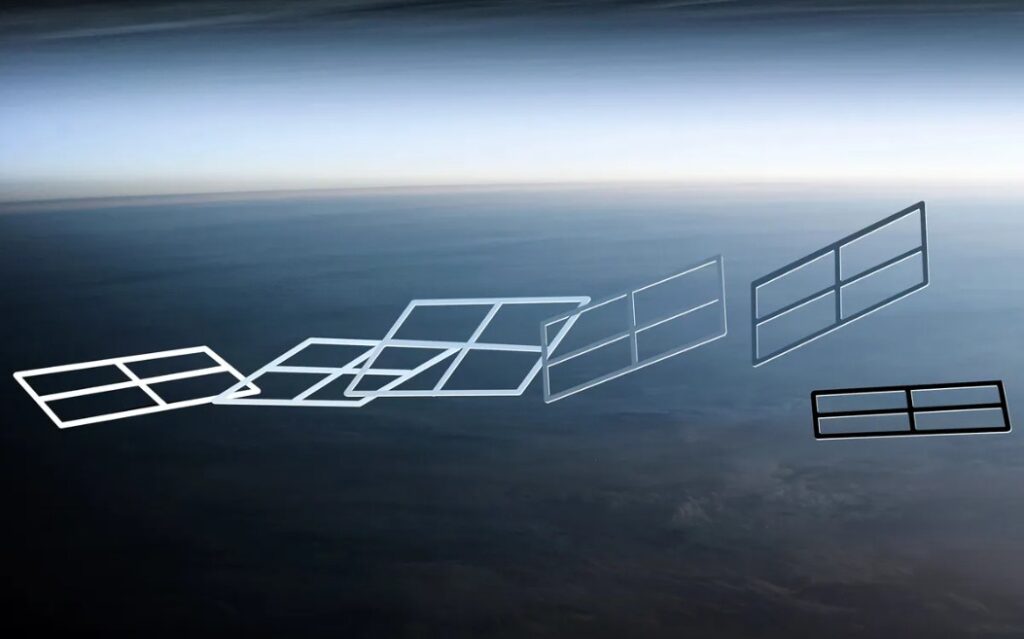
We’ve treated the mesosphere like a mystery zone: too high for planes or balloons, too low for satellites. That’s why scientists call it the “ignorosphere.” Without reliable data from roughly 50 to 85 km up, forecasts and climate models lack a piece of the puzzle. The mesosphere connects the weather below with space events like solar storms, but our view of it has been mostly guesswork.
Now, researchers from Harvard and the University of Chicago have shown that a novel flight mechanism, photophoresis, could power stable platforms in this zone. In simple terms, photophoresis occurs when gas molecules hit the sunlit side of a tiny object harder than they hit its shaded side. That tiny force can lift ultra-light, centimeter-scale structures in low-pressure environments such as the mesosphere, tells IEEE Spectrum.
Their lab tests used a vacuum chamber mimicking mesosphere pressure and managed to levitate a structure with only 55% of sunlight. It’s the first working prototype of a photophoresis-driven flyer tested at those altitudes.
These levitating sensors could hover where no other platform can—gathering long-term measurements in a layer critical for weather predictions, climate science, and understanding how ground-level and space weather interact. Plus, the concept isn’t limited to Earth; it could work in Mars’s thin atmosphere or on other planets with sparse air.
To move from lab to field, engineering needs to catch up; prototypes currently lack onboard sensors, transmitters, or communications gear. But the researchers are optimistic. They’ve even launched a startup, Rarefied Technologies, to push this toward real-world deployment.
Photophoretic flyers may be the first reliable, long-term window into the mesosphere, finally illuminating one of our atmosphere’s darkest blind spots.
