

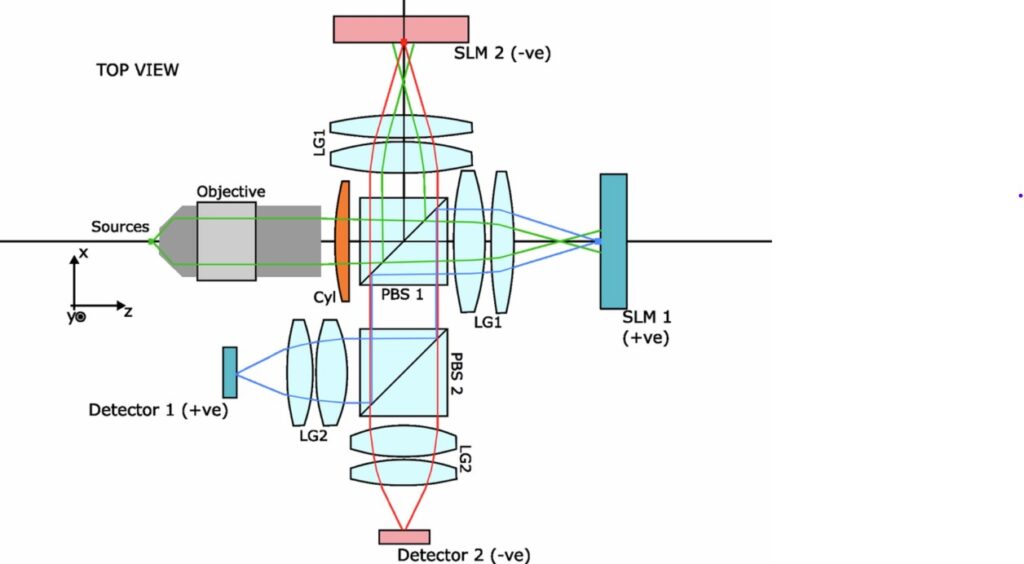
Microsoft researchers, teaming up with Cambridge University, have unveiled a prototype analog optical computer (AOC). It stands out because it uses light, not electricity, to perform computations, bypassing energy-heavy digital conversions, reports Tech Xplore.
At its core, the AOC blends micro-LED arrays, spatial light modulators, and photodetectors to conduct arithmetic operations directly in analog form. That means instead of converting data between analog and digital, calculations happen in one fluid step, boosting efficiency.
The team paired this hardware with a “digital twin,” a software model that mirrors the AOC’s behavior. Together, they tackled real-world tasks like classifying images, solving nonlinear regression problems, reconstructing MRI scans, and even modeling complex financial transactions. Results were promising: the digital twin matched hardware outcomes with over 99% accuracy, and MRI reconstructions shrank from 30 minutes down to just 5.
Microsoft estimates this analog approach offers up to 100 times the energy efficiency of today’s leading GPUs, thanks to fixed-point search techniques that run noise-resistant iterative calculations.
Crucially, the AOC isn’t a general-purpose computer; it shines on specific AI inference and optimization workloads, where its analog nature and hardware-software synergy deliver real advantages.
Microsoft is making the hardware optimizer algorithm and digital twin publicly available. That signals a push for wider research and real-world adoption toward a more sustainable computing future.
