

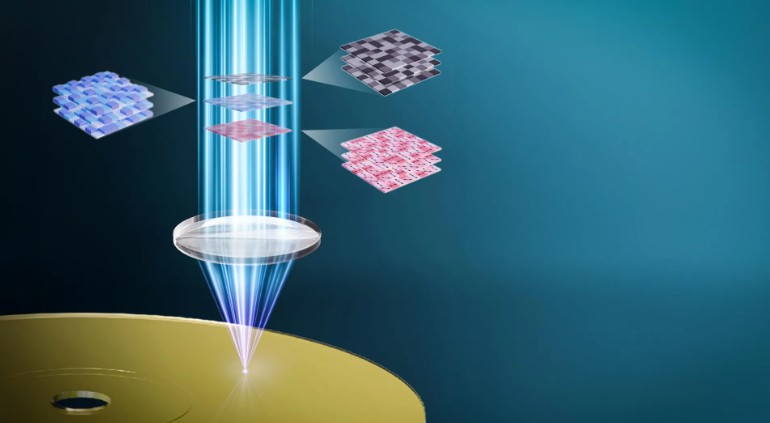
A new approach to data storage is redefining how information can be encoded, moving beyond flat, surface-based systems into fully three-dimensional space. Researchers have developed a holographic technique that uses multiple properties of light simultaneously to dramatically increase storage density and efficiency, tells Science Daily.
Conventional storage technologies, such as hard drives and optical discs, record data on two-dimensional surfaces. In contrast, holographic storage embeds information throughout the volume of a material using laser-generated light patterns. This allows multiple layers of data to coexist in the same physical space, significantly expanding storage capacity.
The key innovation lies in combining three independent properties of light, amplitude, phase, and polarization, to encode information. Earlier systems typically relied on one or two of these dimensions, limiting how much data could be stored. By introducing polarization as an additional channel, the researchers created a multidimensional encoding strategy that increases the information carried by each data “page.”
Decoding such complex data presents a major challenge, since standard sensors primarily measure light intensity and cannot directly capture phase or polarization. To overcome this, the team integrated a convolutional neural network that reconstructs all three properties from diffraction patterns. By analyzing paired images captured under different conditions, the AI model learns to recover the full dataset efficiently.
The result is a compact system capable of recording and retrieving high-density information with improved speed and reduced complexity. Tests confirmed that multidimensional encoding increases storage capacity while simplifying the readout process, making the technology more practical for real-world applications.
Although still in development, the approach points toward a new generation of storage systems. Future work will focus on improving material stability, increasing encoding resolution, and integrating multiplexing techniques to store even more data simultaneously.
If successfully scaled, this technology could reshape data infrastructure by enabling smaller, more efficient storage systems while supporting faster data processing and secure optical communication.
