

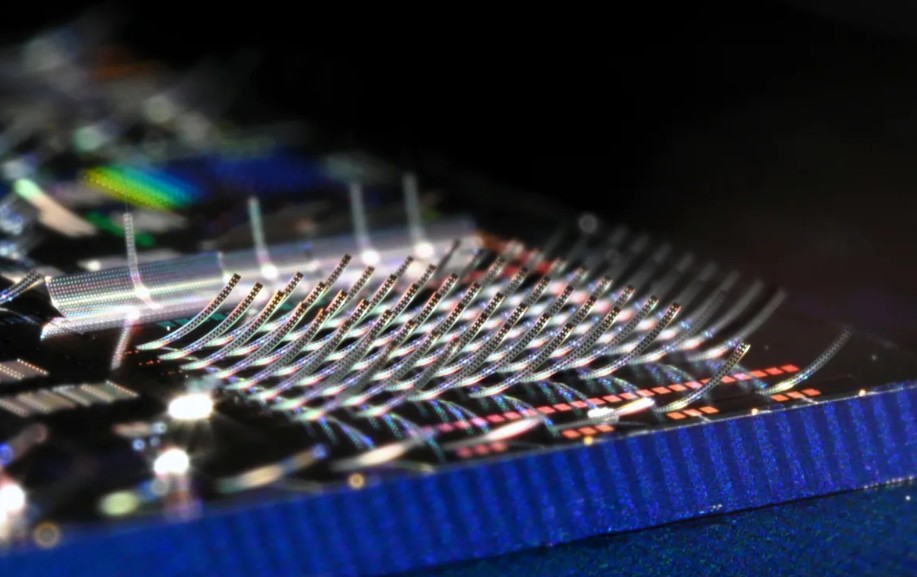
A new generation of photonic chips is redefining what it means to control light at scale. By combining microelectromechanical systems (MEMS) with photonics, researchers have created devices capable of directing vast numbers of laser beams with extraordinary precision. At the center of this breakthrough is a millimeter-scale chip that can project millions of light points, effectively turning a single optical system into a massively parallel tool, tells IEEE Spectrum.
The technology emerged from efforts to solve a major bottleneck in quantum computing. Many quantum systems require precise control of individual qubits using lasers, but scaling this approach to millions of qubits has proven impractical with conventional methods. Instead of assigning one laser per qubit, the MEMS-based chip rapidly steers beams across a two-dimensional field, enabling a smaller number of lasers to control a far larger system. This approach offers a path toward scalable quantum machines without the prohibitive complexity of traditional setups.
The implications extend well beyond quantum computing. The same ability to project and scan thousands of beams simultaneously could dramatically accelerate processes such as 3D printing. Current systems often rely on a single laser scanning line by line, a time-consuming method. With MEMS photonics, parallel beams could reduce production times from hours to minutes, fundamentally changing throughput in additive manufacturing.
Imaging and biomedical applications also stand to benefit. The chip’s precision and flexibility allow it to scan or stimulate microscopic regions with high accuracy, opening possibilities for advanced diagnostics and lab-on-a-chip systems. Researchers are already experimenting with different MEMS structures, including helical cantilevers, to expand the range of optical manipulation techniques.
At a broader level, MEMS photonics represents a shift toward integrating mechanical motion with light-based systems on a single chip. This fusion enables compact, low-power, and highly adaptable devices that overcome limitations of traditional photonics. As development continues, the technology could become a foundational tool across fields that depend on fast, precise control of light, from computing to manufacturing and medicine.
