

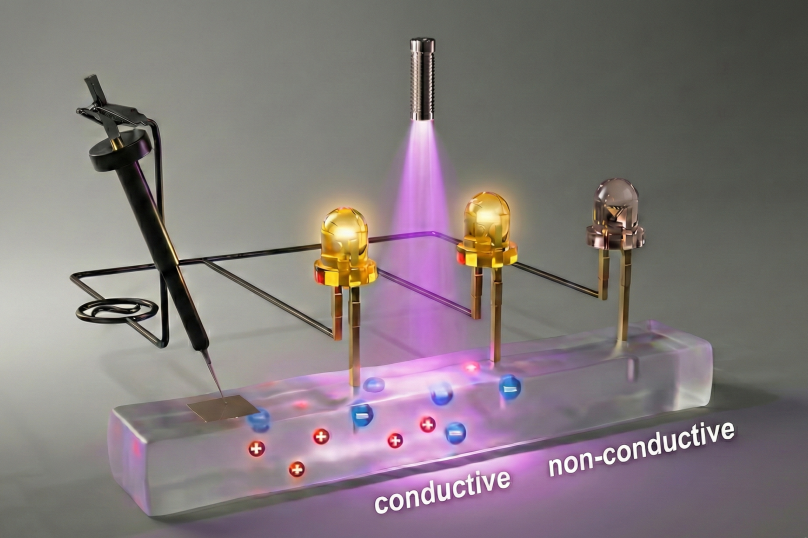
A new class of soft material developed by researchers at Massachusetts Institute of Technology signals a shift in how electronics can interact with living systems. The team has engineered a flexible gel whose electrical conductivity can be precisely controlled using light, enabling dynamic behavior in materials that were previously static, tells MIT News.
The innovation sits within the emerging field of ionotronics, where signals are transmitted through ions rather than electrons. While conventional electronics rely on rigid components and electron flow, biological systems operate through soft, ion-based communication. This gel bridges that gap, offering a platform that behaves more like living tissue while retaining electronic functionality.
At the core of the material is a compound known as a photo-ion generator. When exposed to light, it releases charged particles that dramatically increase the gel’s conductivity, in some cases by up to 400 times. This transition is reversible and spatially controllable, allowing specific regions of the material to switch between insulating and conductive states. Researchers demonstrated this capability by activating sections of a soft circuit with light, effectively turning pathways on and off without physical wiring.
Unlike earlier ionotronic materials, which offered high conductivity but little control, this approach enables localized and dynamic tuning. The result is a system that can respond to environmental stimuli in real time, adjusting its behavior based on external conditions such as light exposure.
Potential applications span a wide range of technologies. In wearable devices, the gel could lead to more comfortable, adaptive sensors that conform to the body. In soft robotics, it could enable machines that process signals and respond without rigid electronics, improving safety and flexibility in human-facing environments. The material also holds promise for advanced human–machine interfaces, where seamless integration with biological tissue is essential.
By combining softness, responsiveness, and controllable conductivity, the work points toward a future where electronics are no longer confined to rigid forms. Instead, they may become fluid, adaptive systems that operate more like the biological networks they aim to complement.
