

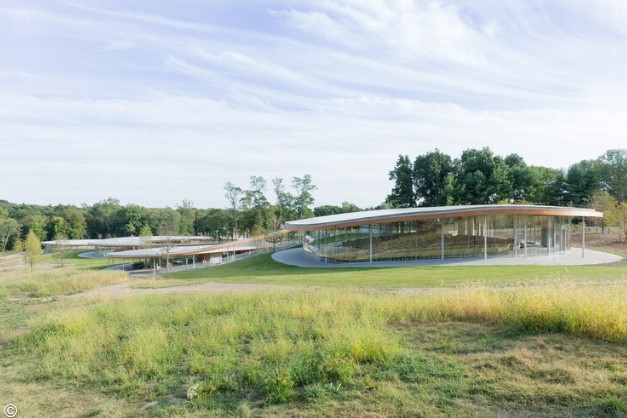
The pursuit of lightness has long shaped modern architecture, redefining how buildings relate to structure, material, and perception. While lightweight design is often associated with efficiency and sustainability, the ArchDaily article argues that this perception can be misleading. What appears visually light may, in reality, carry significant environmental costs.
Architectural lightness is largely a perceptual construct. Techniques such as cantilevers, minimal supports, and expansive glass façades create the impression of reduced mass, even when these structures rely on substantial amounts of material and engineering complexity. A building that appears to float or dissolve into its surroundings may still depend on intensive use of steel, concrete, and layered systems to maintain structural and thermal performance.
This disconnect becomes more pronounced when considering material production. Lightweight systems often rely on advanced materials such as aluminum, high-performance glass, polymers, and composites. These materials require energy-intensive extraction, processing, and manufacturing, meaning much of their environmental footprint occurs before construction is complete. As a result, reducing visible mass on-site can shift environmental impact upstream into global supply chains.
The article challenges the assumption that “less material” automatically means “less impact.” In some cases, heavier, locally sourced materials such as masonry or rammed earth may have lower overall environmental costs due to reduced processing and transportation. Conversely, materials often considered sustainable, like timber or bamboo, can lose their advantages when sourced or processed through energy-intensive global networks.
Examples such as ETFE membranes further illustrate the paradox. These ultra-light systems replace traditional assemblies with minimal weight, yet depend on complex petrochemical processes and specialized manufacturing. Their efficiency in use does not negate the environmental burden embedded in their production.
Ultimately, the article reframes lightness as a critical concept rather than a straightforward solution. Sustainable architecture requires evaluating the full life cycle of materials, from extraction to use, rather than focusing solely on visual or structural reduction. What matters is not just how lightly a building touches the ground, but where and how its environmental impact is distributed.
This perspective encourages a more nuanced approach to design, where lightness is balanced with responsibility, transparency, and a deeper understanding of material consequences.
