

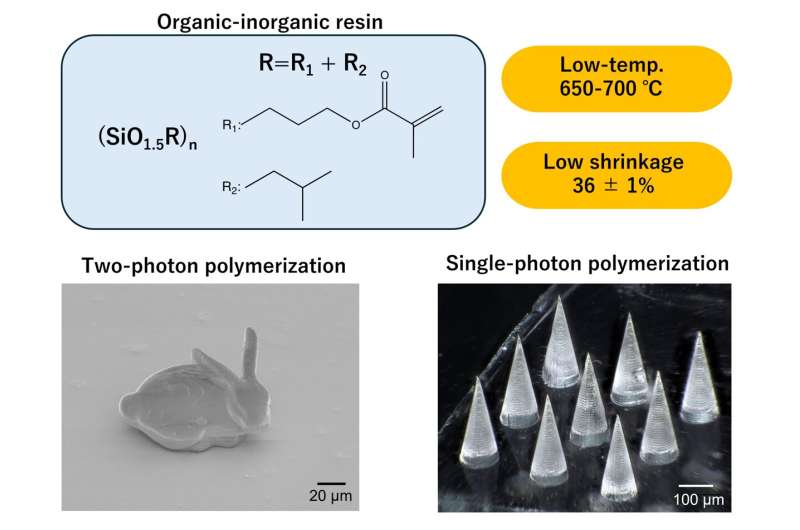
Researchers at Yokohama National University have developed a new route to manufacture transparent silica glass using 3D printing that cuts the required processing temperature nearly in half compared with traditional approaches, tells Tech Xplore. Their work relies on a novel organic-inorganic hybrid resin based on polyhedral oligomeric silsesquioxane (POSS), which enables “sinterless” processing, converting a printed structure into solid glass without the high-heat sintering required by conventional methods. This innovation makes glass additive manufacturing more practical for complex shapes and finer details.
Conventional stereolithography applied to silica glass typically uses a slurry of silica particles and organic monomers. After printing, these parts must be heated above 1000°C to remove organics and fuse particles into dense glass. This high temperature limits integration with other materials, increases warping and cracking, and drives up cost. The new POSS-based resin achieves transparent fused silica at calcination temperatures of around 650–700°C while maintaining high printing precision. The resin also exhibits significantly reduced shrinkage during conversion, about 36%, which lowers defects in larger structures.
Because the resin is particle-free and retains a high silica content, it works with both high-resolution two-photon polymerization and more accessible single-photon stereolithography. That adaptability means manufacturers could produce multi-scale devices, from microscopic components such as microfluidic channels and optical elements to larger transparent glass parts in a unified process. The research team sees potential pathways to 3D print centimeter-scale glass objects with submicron detail by combining different polymerization techniques and integrating this low-temperature method with semiconductor, micro-electromechanical systems, and photonic device fabrication.
