

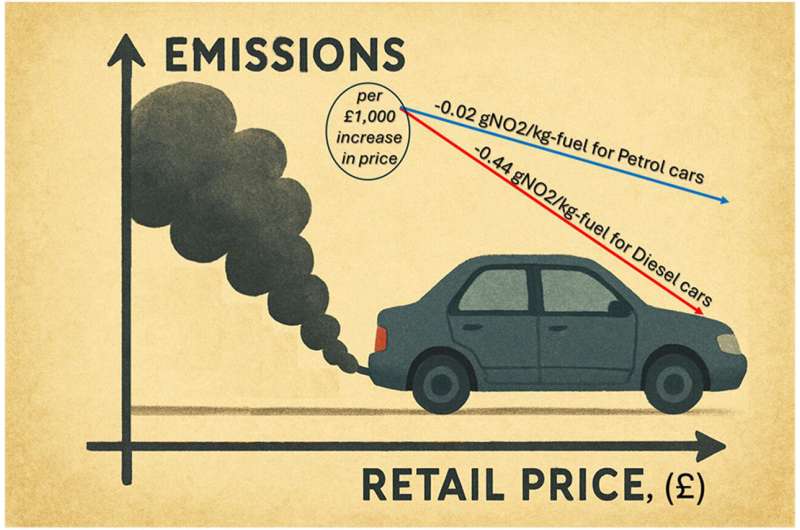
A team from the University of Birmingham has found that cheaper cars emit more pollutants in urban areas, creating an overlooked inequality in air-quality impact. The research shows that owners of lower-cost vehicles tend to produce higher levels of emissions, while more expensive cars generate lower pollution levels, despite similar usage in city settings, tells Tech Xplore.
The findings highlight that affordability and emissions are tied: individuals from lower-income brackets are more likely to own older or less efficient vehicles that deliver greater emissions per kilometer. This segment, therefore, contributes disproportionately to local urban air pollution burdens. The study argues this represents an “emissions inequality,” not only in exposure to pollution but also in contribution.
The data suggest two practical consequences. First, efforts to reduce urban vehicle pollution may be undermined if policy focuses only on overall fleet averages without addressing the higher-emitting tail of cheaper vehicles. Second, interventions aimed at affordability, such as incentives or scrappage schemes for older vehicles, may deliver emissions dividends and promote equity. The paper urges regulators and city planners to consider vehicle cost as a proxy for emissions risk, particularly in dense urban zones where local air quality and human health are affected.
In sum, while the push toward electric vehicles and tighter emission standards remains vital, this research underscores that policy must also reach the lower end of the market. Without addressing the higher-emitting, cheaper vehicles, urban air-quality gains may stall, and existing socioeconomic divides may widen. Engineers, urban planners, and regulators should view vehicle purchasing cost not just as an economic metric but as an emissions-risk indicator.
