

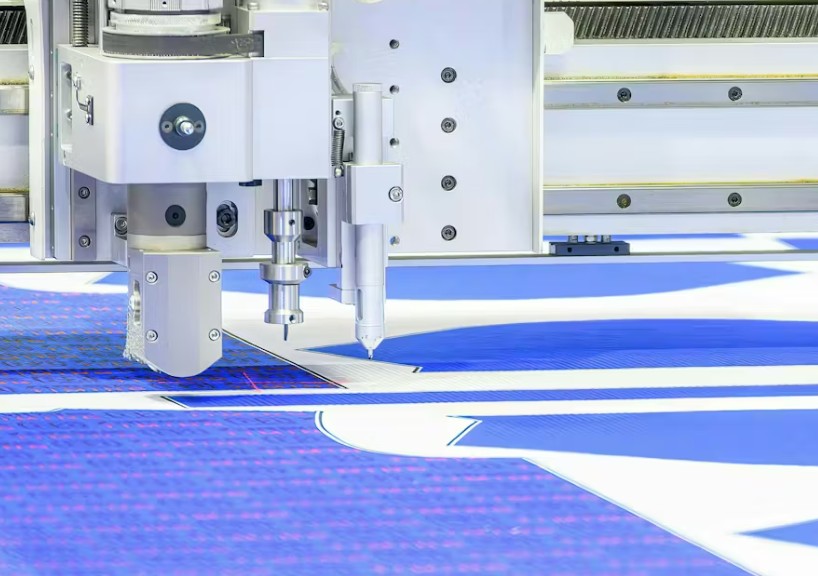
Engineering has long relied on the assumption that objects behave as rigid bodies, with fixed shapes and predictable motion. However, many real-world materials, from fabrics to biological tissues, do not follow these rules. A recent article in Machine Design explores how engineers are developing new kinematic mapping techniques to better understand and control such non-rigid systems.
Traditional kinematics works well when dealing with solid components such as gears or metal structures, where motion can be described using fixed coordinate frames. In contrast, non-rigid materials introduce variability in shape, deformation, and motion, making their behavior far more complex. For example, handling fabric in automated sewing presents unique challenges because the material bends, stretches, and shifts unpredictably during processing.
To address this, engineers are moving beyond conventional models and incorporating real-time sensing, high-resolution actuators, and advanced control systems. In one example, fluid-powered mechanisms were replaced with precise servomotors and linkages that track material position dynamically. This allows machines to respond instantly to changes in the material’s geometry, improving accuracy and consistency.
A key concept in this shift is kinematic mapping, which links the deformation of a material to its motion in space. Instead of treating an object as a single rigid entity, engineers model it as a system with many degrees of freedom. This approach captures how local changes, such as bending or stretching, affect the overall movement of the material.
These advances are especially important for automation in industries such as textiles, robotics, and soft manufacturing, where handling flexible materials has traditionally required human skill. By combining sensing, control, and modeling, engineers are beginning to replicate that adaptability in machines.
The transition from rigid-body assumptions to flexible kinematic models marks a significant evolution in engineering design. It opens the door to more capable automation systems that can interact with complex, deformable materials in ways that were previously difficult to achieve.
