

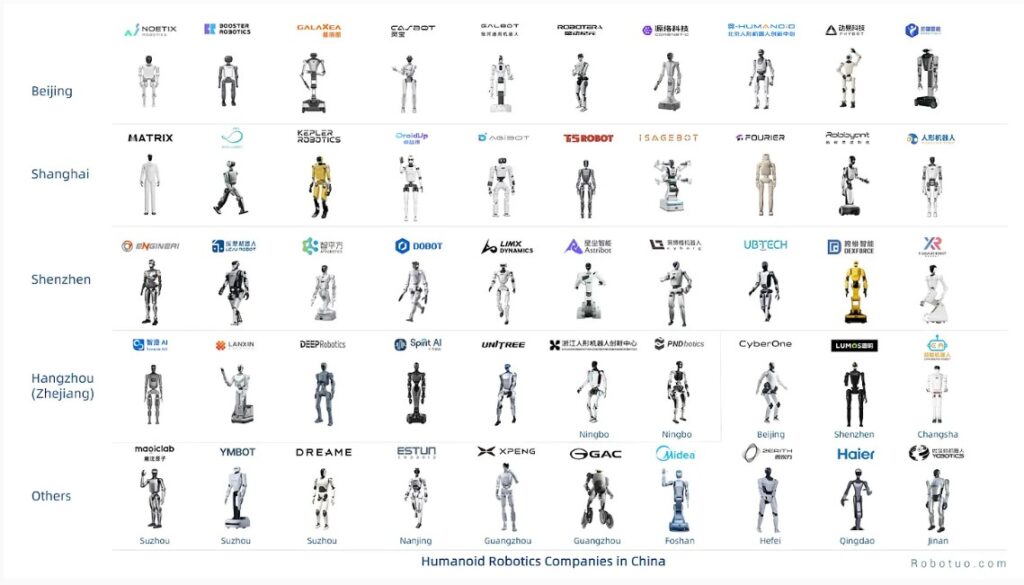
A recent Hardware FYI edition presents a global map of humanoid robotics startups that reveals rapid evolution in a field once dominated by speculative demos and theory. What was once mostly concept work, epitomized by early promotional stunts such as Tesla’s robot reveal featuring a person in a suit, has in just a few years grown into dense clusters of serious companies across major regions, notably the United States, Europe, and China.
The chart from RoboTuo breaks the landscape down at the city level, showing concentrations of teams in tech hubs where talent, capital, and supply chains are strongest. These clusters suggest that humanoid robotics is no longer scattered or fringe; instead, it’s becoming a structured industry with multiple players tackling various challenges simultaneously, from actuation and sensing to autonomy and integration.
The newsletter points out that the enabling factors behind this shift are falling costs in electric actuation and batteries, more mature supply chains (borrowed from electric vehicles and other sectors), and substantial improvements in AI and control software that give robots a better chance of operating in real environments.
This transformation parallels earlier robotics waves. In the 2010s, the hot category was warehouse automation, where autonomous mobile robots moved goods around fulfillment centers. That sector grew rapidly but eventually matured and consolidated; some leaders were acquired and wound down. The current humanoid wave appears broader and more sustained, with startups pursuing long-term bets rather than just incremental automation.
The map doesn’t predict which companies will succeed, and the Hardware FYI article emphasizes that unit economics and deployment realities will ultimately decide who thrives. But the density of teams right now shows that humanoid robotics has moved beyond prototype curiosity to a crowded, geographically diverse ecosystem of companies aiming for real products and real markets.
