

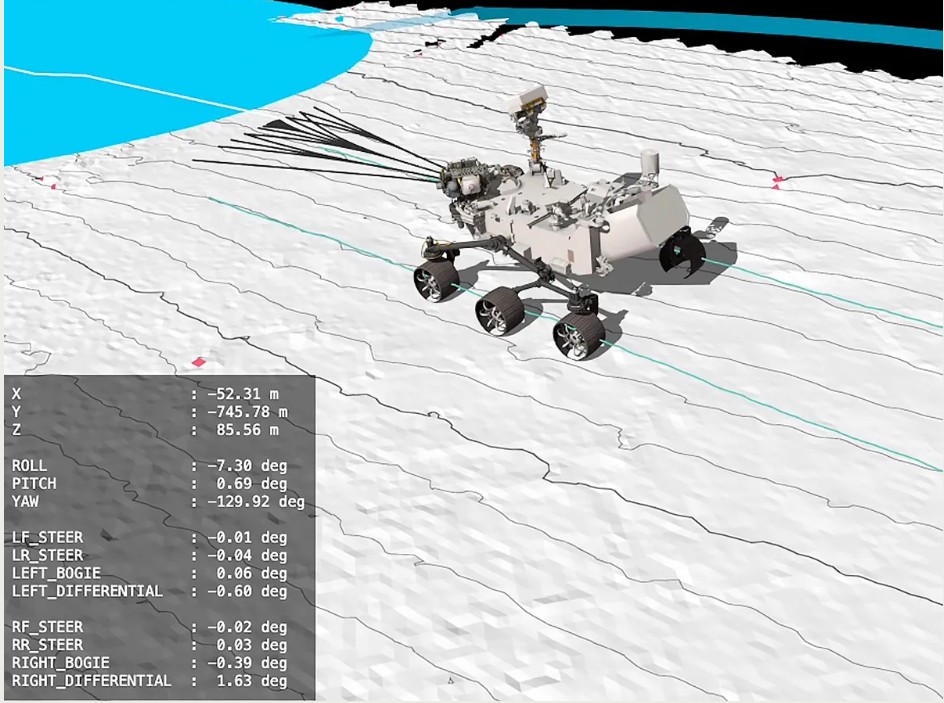
NASA has taken a notable step toward more autonomous planetary exploration by letting artificial intelligence plan drives for the Perseverance Mars rover, tells IEEE Spectrum. In a recent mission demonstration, generative AI based on Anthropic’s Claude model analyzed high-resolution images and terrain data to identify hazards such as rocks, sand traps, and uneven slopes, then plotted a set of waypoints for the rover to follow. Those AI-generated waypoints were tested first on an engineering model on Earth and then sent to Perseverance on Mars, where they guided two drives totaling about 456 meters without direct human control.
The need for this kind of autonomy comes from the communication delay between Earth and Mars, which can exceed 20 minutes round-trip. Traditionally, human rover planners at NASA’s Jet Propulsion Laboratory examine imagery and elevation datasets and manually chart routes in small segments. With AI planning ahead, Perseverance can respond to its environment more quickly and traverse challenging terrain more efficiently.
Generating waypoints this way doesn’t eliminate human oversight. Engineers still validate and vet the plans before transmission, and existing onboard navigation systems handle obstacle avoidance as the rover moves. But the demonstration shows that AI can shoulder part of the onerous route-planning task, freeing mission teams to focus on science and long-term strategy.
Experts involved in the project see generative AI as a tool that could expand the distance future rovers travel and reduce operational delays. By augmenting perception, localization, and planning functions, AI could let robotic explorers adapt to unknown surfaces with less ground intervention. This work lays a foundation for more autonomous exploration not just on Mars but for missions farther afield, where long communication delays make real-time control impractical.
In essence, the integration of generative AI into rover navigation marks a shift toward smarter, more self-sufficient robotics on other worlds, a capability that will be critical as missions venture beyond Mars.
