

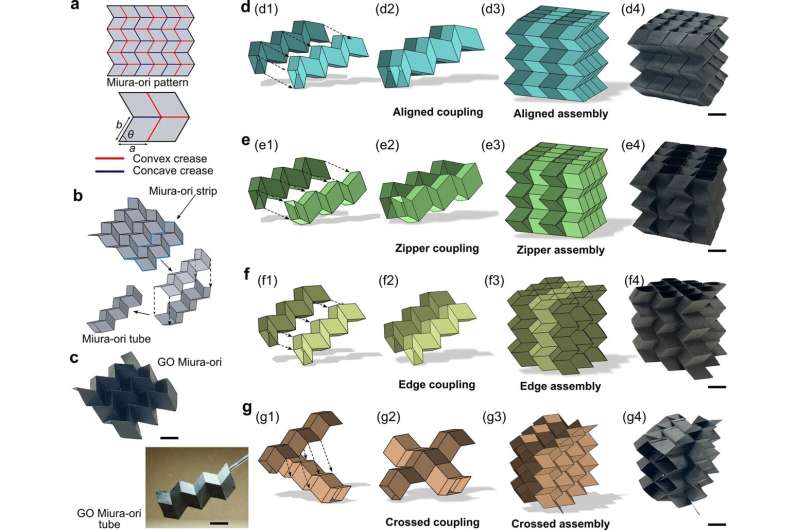
Researchers at McGill University have developed ultra-thin, programmable materials that can fold, twist, and reshape themselves, creating a new class of soft matter with movement built into its architecture. Tech Xplore tells that these materials behave much like animated origami, turning simple, paper-like sheets into tiny devices that can walk, flip, and sense their own motion. The work advances possibilities for the next generation of soft robots that are safer, lighter, and more adaptable than rigid machines.
The core of the research lies in architected sheets made from folded graphene oxide. These sheets can be programmed at the material level to respond to external stimuli. In one set of experiments, the materials changed shape when exposed to variations in humidity. In another, magnetic fields triggered movements. These triggers cause controlled bending, twisting, and locomotion without traditional motors or actuators, significantly reducing complexity and energy requirements.
The programmable nature of the material opens doors to applications well beyond soft robotics. In medicine, such systems could serve as tiny tools that gently navigate inside the body or adapt to changing conditions on the skin for wearable devices. Smart packaging that reacts to its environment is another potential use, offering new ways to monitor or protect contents.
Crucially, the materials can be produced at scale, a key step toward practical implementation. By combining simple fabrication techniques with programmable responses, researchers have shown that these materials can be made reliably and in larger quantities than many experimental soft-robot systems.
This work highlights a broader trend in robotics and materials science toward systems that borrow design principles from biology and mechanics, relying on embedded material properties for actuation and sensing rather than on bulky external hardware. The result could be a new generation of machines that operate more safely alongside humans and function more effectively in complex environments.
