

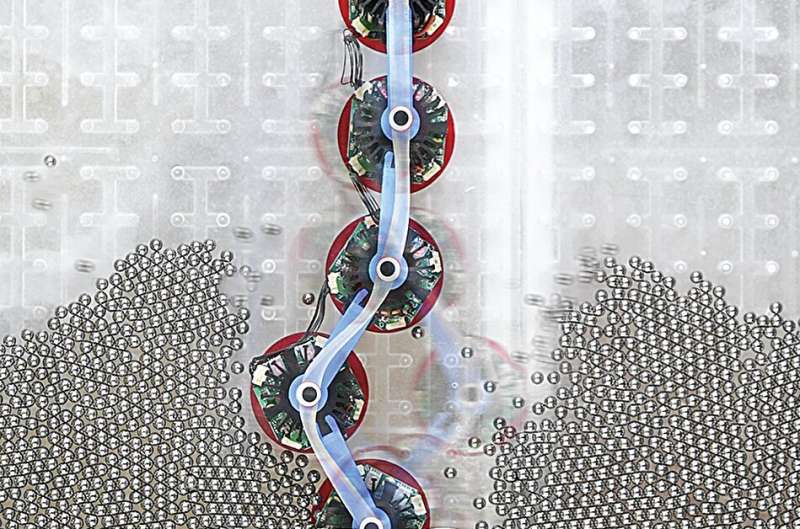
Materials have traditionally been defined by their passive response to external forces, bending or stretching when pushed or pulled. New research is overturning that assumption by introducing “active” materials that do far more than deform. These systems can snap, crawl, walk, and even dig autonomously, powered by internal activity rather than external control, tells Tech Xplore.
At the core of this behavior are structures known as active lattices, where individual components generate motion or energy within the material itself. Instead of responding predictably to stress, these materials exhibit complex, coordinated behavior that resembles living systems. In some cases, increasing the activity of individual elements produces a counterintuitive result: the overall motion of the material decreases. This phenomenon challenges established physical principles such as Le Chatelier’s principle, which predicts that systems should respond to disturbances in ways that counteract them.
The key lies in how active elements connect and interact. When these components form continuous, percolating networks, their collective behavior enables large-scale motion. But when the network is fragmented, adding more activity can disrupt coordination, reducing the material’s ability to move effectively. This delicate balance between structure and activity defines the material’s emergent properties.
These findings open new possibilities for soft robotics and adaptive materials. Instead of designing machines with motors and rigid joints, engineers could create materials that inherently move and respond to their environment. Such systems could lead to self-propelling robots, materials that navigate confined spaces, or structures that dynamically adapt their shape and function.
While still at an early stage, this research points toward a shift in materials science. Rather than building static components, scientists are beginning to design matter that behaves more like a system, capable of autonomous action and complex responses. The boundary between material and machine is starting to blur, with implications for engineering, robotics, and beyond.
