

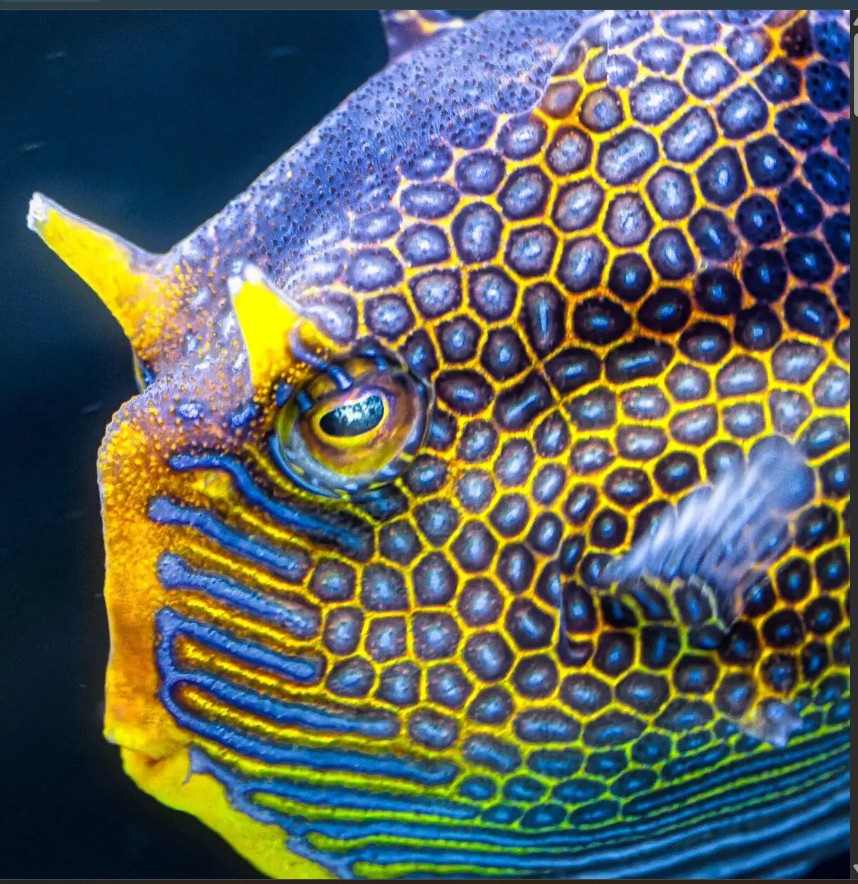
The ornate boxfish, an Australian species known for its intricate spots and hexagonal skin patterns, has become the focus of a new study linking biology and mathematics. Engineers Siamak Mirfendereski and Ankur Gupta from the University of Colorado Boulder developed a mathematical model that accurately recreates these complex designs, offering a window into how natural patterns emerge, according to this New York Times article. Their study, published in the journal Matter, builds on Alan Turing’s 1952 theory describing how chemical reactions and diffusion can spontaneously form shapes such as stripes and spots, now known as Turing patterns.
Turing’s model explained the formation of natural designs, from leopard spots to seashell swirls, but often failed to capture the irregularities seen in real organisms. Dr. Gupta’s team refined this by introducing diffusiophoresis, a process where cells move collectively in response to surrounding particles, similar to how soap lifts dirt in water. This modification sharpened the simulated boxfish patterns and gave them realistic texture and variation.
Graduate student contributions further enhanced the model by accounting for pigment cells colliding and interacting, producing naturally imperfect yet visually convincing results. The resulting simulations featured broken stripes, uneven hexagons, and blurred edges, flaws that mirrored living systems.
Though still simplified, this model bridges the gap between theoretical predictions and biological reality. Beyond scientific curiosity, the research could inform the design of bio-inspired materials for camouflage, textiles, and soft robotics. Dr. Gupta emphasized that understanding these “messy but beautiful” imperfections may one day enable engineers to control pattern formation across materials, organisms, and machines, continuing the legacy of Turing’s pioneering mathematics.
