

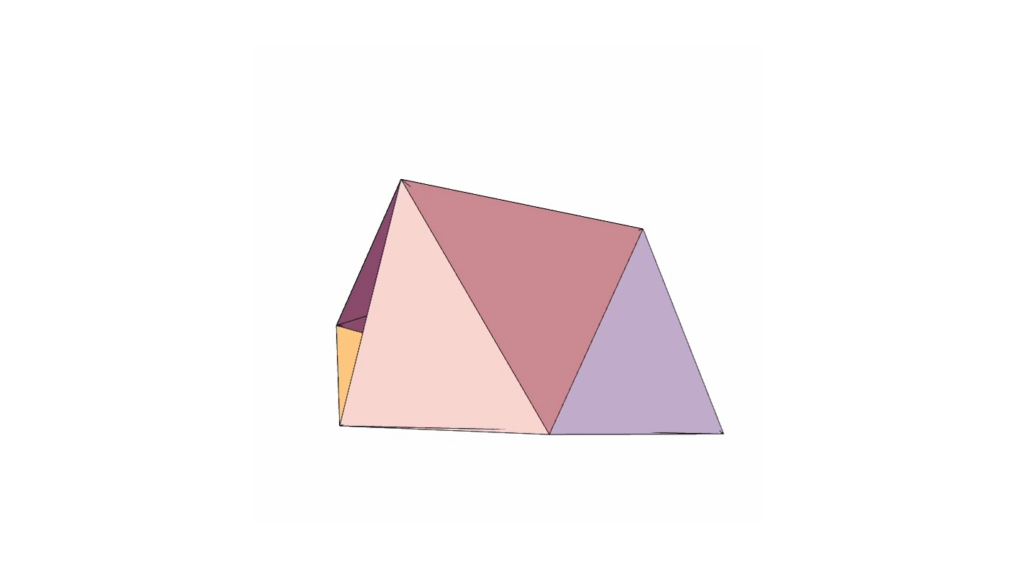
A longstanding question in the mathematics of origami has finally been answered. Researchers have determined the smallest number of folds required to create a torus, the doughnut-shaped geometric form with a hole through its center, from a flat sheet of paper. The result combines computational geometry, topology, and paper-folding theory, demonstrating how abstract mathematics can solve problems rooted in a centuries-old art form, tells Science News.
Mathematician Richard Evan Schwartz of Brown University carried out the work. Rather than physically folding paper, Schwartz relied largely on computer-based mathematical analysis. His research shows that the most efficient origami torus requires 24 folds arranged into 16 triangular faces that meet at eight vertices. The proof also establishes that no torus can be constructed with fewer than eight vertices, resolving a problem that had remained open for years.
A torus can be imagined as a tube bent into a closed loop, but creating one from paper without awkward crumpling presents a much greater challenge. Origami mathematicians study crease patterns that allow flat sheets to transform into complex three-dimensional forms through precise geometric arrangements. In this case, the goal was to identify the simplest possible structure capable of forming a torus while preserving the mathematical rules governing paper folding.
The research belongs to the growing field of computational origami, where algorithms and geometry are used to analyze folding systems. Although the problem may appear purely theoretical, the mathematics behind origami has influenced engineering applications ranging from deployable space structures and satellite components to medical devices and advanced materials. Folding principles help engineers design compact structures that can expand efficiently when needed.
Schwartz is known for investigating minimal geometric forms and previously studied the shortest possible Möbius strip. His latest result highlights the continuing relationship between art and mathematics, showing that even a simple sheet of paper can reveal deep geometric truths. By identifying the most efficient origami torus, the work offers both a solution to a mathematical puzzle and a new benchmark for researchers exploring the science of folding.
