

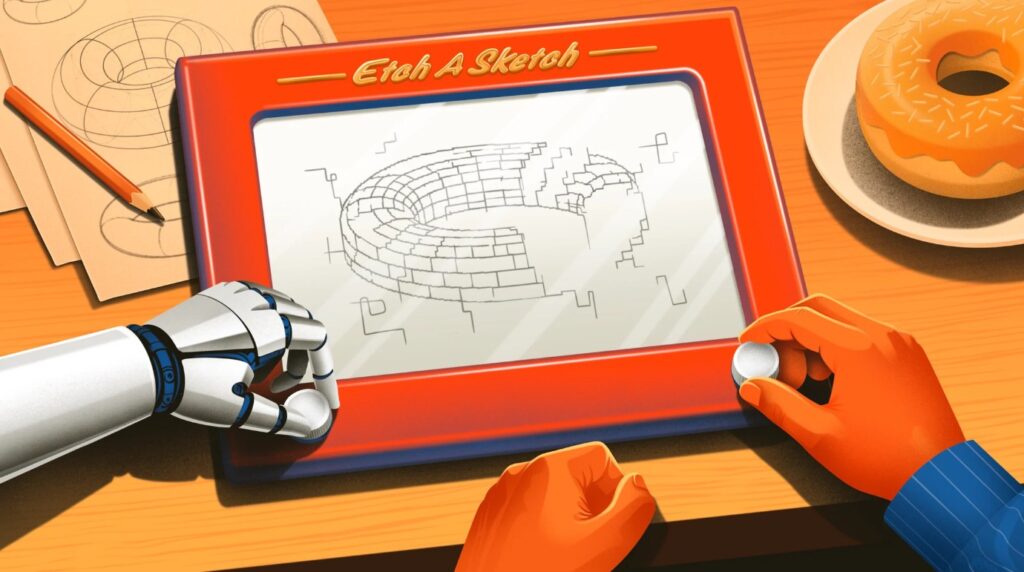
Artificial intelligence is beginning to transform mathematics from a slow, individual pursuit into a faster, more collaborative process between humans and machines. A turning point came in 2025, when AI systems solved five out of six problems at the International Mathematical Olympiad, surprising researchers and forcing a reassessment of AI’s potential in the field, tells Quanta Magazine.
Initially, many mathematicians dismissed these achievements, noting that Olympiad problems have known solutions. But as researchers began experimenting with AI tools, they found that the systems could contribute to genuine mathematical discovery. AI models are now being used to generate conjectures, explore solution pathways, and even produce complete proofs, sometimes accomplishing in a single day what previously required weeks or months of work.
The collaboration between humans and AI is key. Rather than replacing mathematicians, AI acts as a powerful assistant, rapidly testing ideas, identifying patterns, and suggesting new approaches. Mathematicians often guide the process, verifying results and refining partial insights produced by the models. This iterative exchange allows researchers to explore far more possibilities than they could alone.
The impact extends beyond speed. AI enables a shift in methodology, allowing mathematicians to tackle many problems simultaneously and even conduct statistical analyses across large sets of mathematical questions. This marks a departure from the traditional approach of focusing deeply on a single problem at a time.
Despite these advances, limitations remain. AI-generated results are not always reliable, and human oversight is essential to ensure correctness. Moreover, no one expects AI to replace the creative intuition that drives breakthroughs. Instead, the technology is reshaping the practice of mathematics itself, introducing new tools, workflows, and ways of thinking.
As adoption grows, the field may undergo broader cultural and institutional changes. Mathematics is not being automated away but expanded, with AI opening new avenues for discovery while redefining the role of the mathematician in the process.
