

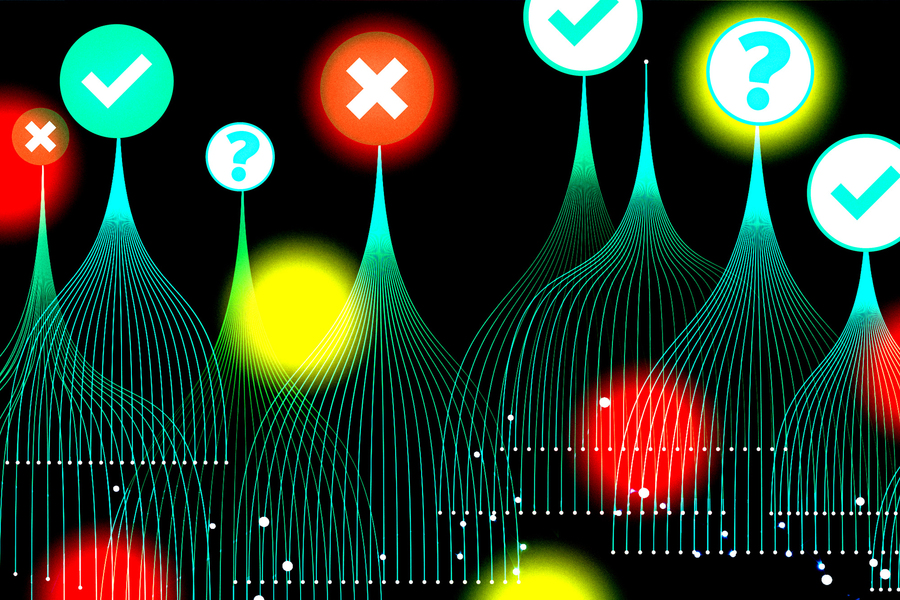
The MIT News article introduces a new method for identifying when large language models (LLMs) are overconfident, a persistent issue that undermines trust in AI systems. While modern models often produce fluent and convincing answers, they can express high confidence even when their responses are incorrect, making it difficult for users to judge reliability.
Traditional approaches to evaluating model confidence rely on internal signals, such as probability scores assigned to generated words. However, these signals do not always reflect true uncertainty, especially in complex or unfamiliar tasks. As a result, models may appear more certain than they should, increasing the risk of hallucinations or misleading outputs.
To address this, MIT researchers developed a new technique that measures what they call “total uncertainty.” Instead of relying solely on a single model’s internal confidence, the method compares outputs across multiple models or variations of the same model. By analyzing how consistent or inconsistent these outputs are, the system can better estimate whether a prediction is reliable.
If multiple models produce similar answers, the prediction is likely more trustworthy. But when outputs diverge significantly, the method flags higher uncertainty, even if an individual model appears confident. This cross-model comparison provides a more realistic assessment of reliability, capturing uncertainty that traditional metrics often miss.
The researchers demonstrated that this approach is more effective at identifying overconfidence than existing techniques. It can detect situations where models are likely to hallucinate or provide incorrect information, offering a practical way to improve AI safety and decision-making.
Beyond evaluation, the method has broader implications for deploying AI in high-stakes domains such as healthcare, finance, and engineering. By giving users clearer signals about when to trust or question an output, it helps bridge the gap between model performance and real-world usability.
Ultimately, the work reframes confidence as something that must be validated externally, not assumed from within. Accurate answers matter, but knowing when uncertainty exists may be just as critical for building reliable AI systems.
