

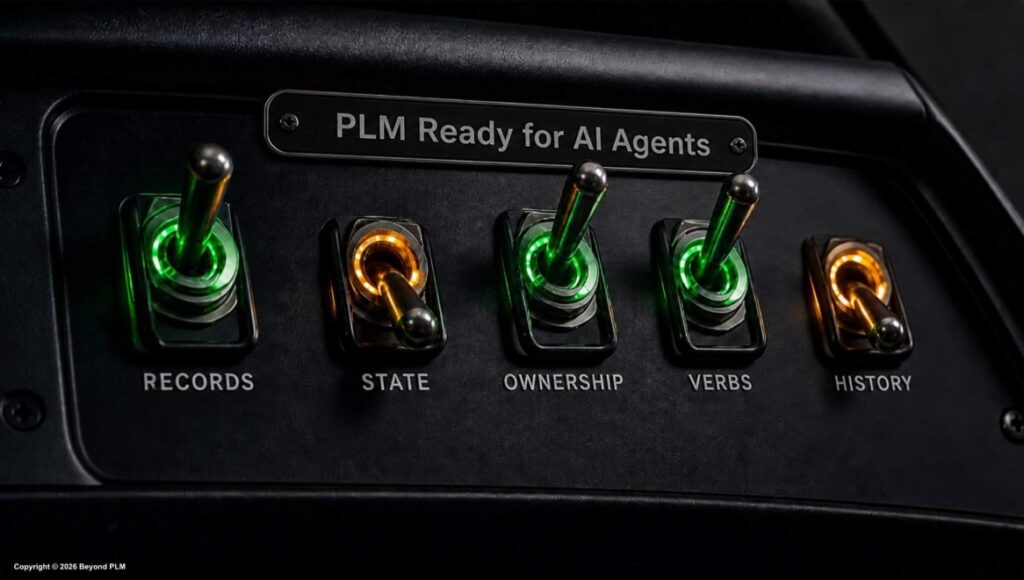
A recent article from the Beyond PLM blog argues that most current PDM and PLM systems are not prepared for the coming wave of AI agents, despite growing excitement around agentic AI in engineering and manufacturing software. The article introduces a diagnostic framework intended to help PLM architects and engineering teams evaluate whether their systems can support AI-driven workflows that rely on autonomous reasoning, contextual understanding, and continuous interaction with product data.
The framework centers on a key distinction between traditional enterprise software and AI-native systems. Conventional PLM platforms were primarily designed for structured workflows, document storage, and controlled processes. AI agents, however, require something more dynamic: accessible product context, interconnected data relationships, machine-readable semantics, and persistent memory structures that allow software agents to reason across engineering domains.
The article outlines several readiness categories. The first is data accessibility, which examines whether product information can be easily retrieved through APIs rather than locked inside isolated files or legacy interfaces. Another category evaluates semantic consistency, ensuring that engineering data uses standardized naming conventions and relationships understandable by AI systems. Additional criteria include workflow observability, event tracking, and the ability to preserve historical engineering reasoning rather than simply storing final outputs.
The article also stresses the importance of “product memory,” a recurring theme in recent discussions about AI-native PLM architectures. The author argues that future AI systems will depend not only on CAD models and metadata but also on contextual engineering knowledge explaining why design decisions were made. Without this deeper layer of traceable reasoning, AI agents may struggle to generate reliable recommendations or automate engineering tasks effectively.
The article further warns that many organizations continue to operate fragmented PLM ecosystems with disconnected databases, proprietary formats, and inconsistent integrations. These limitations create major barriers for AI agents attempting to navigate enterprise engineering environments. Rather than focusing solely on deploying new AI tools, companies are encouraged to first assess the structural quality and interoperability of their underlying systems.
Ultimately, the diagnostic framework positions AI readiness as an architectural challenge rather than a simple software upgrade. The article suggests that organizations able to modernize their PLM foundations may gain significant advantages as AI agents become increasingly embedded within engineering workflows.
