

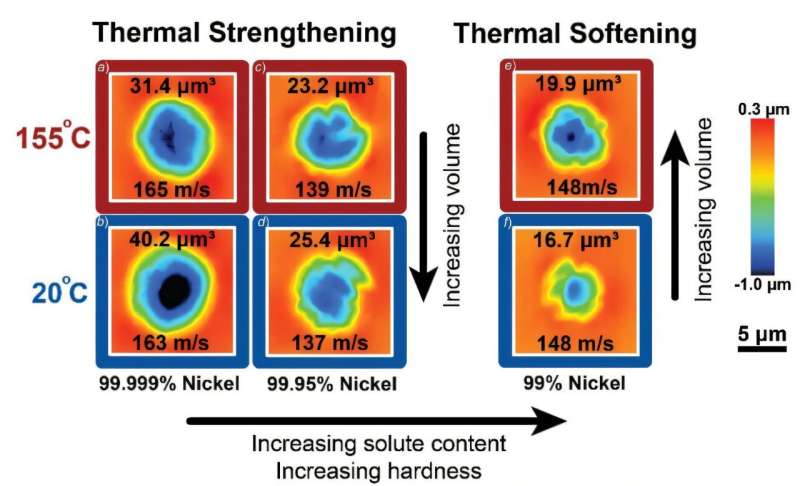
A recent study published in Physical Review Letters and reported by Tech Xplore upends a basic assumption of metallurgy: when pure metals are heated and then bent or dented at extreme rates, they can become stronger rather than softer. Traditionally, heating a metal makes it more malleable and easier to shape, a principle blacksmiths and engineers have relied on for centuries. But researchers at Northwestern University discovered that under conditions of extremely rapid deformation, where a material is struck or stretched millions of times faster than in ordinary processes, rising temperature can actually make pure metals more resistant to deformation. This counterintuitive finding has implications for designing materials for extreme environments such as hypersonic flight, space exploration, and advanced manufacturing.
In controlled experiments, the research team fired microscopic particles at pure metal samples at speeds reaching hundreds of meters per second and at temperatures up to about 155°C. Under these ballistic impacts, pure metals such as nickel exhibited increased strength with temperature, resisting deformation rather than yielding under pressure. Alloyed metals followed conventional behavior, becoming softer as the temperature rose, as expected. The divergence highlights a previously unrecognized regime of material behavior that appears only under very high strain rates and heating.
The unexpected strengthening arises from the atomic vibrations within the heated metal. At normal speeds, heat allows atoms to move more freely, which facilitates deformation. But under extreme speeds, atoms vibrate so intensely that they oppose rapid structural changes caused by the impact. As a result, the metal’s internal dynamics make deformation harder, increasing its effective strength.
This discovery challenges long-held metallurgical principles and points to new directions in materials design. If engineers can harness this behavior, it could lead to metals tailored for extreme conditions in aerospace, defense, and energy applications. It also suggests that our understanding of metal behavior under combined high temperature and high strain rates is still evolving, with practical consequences for constructing components that must endure severe environments.
