

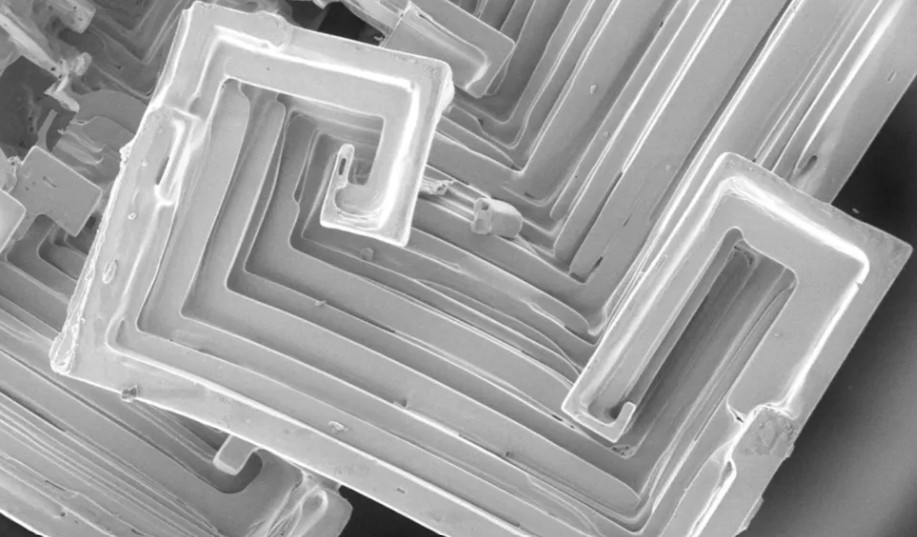
An unusual crystal grown aboard the International Space Station is showing scientists what happens when gravity plays a much smaller role in material formation. NASA astronaut Don Pettit shared an image of potassium chloride crystals forming intricate, hollow structures in microgravity, where other physical forces can become more influential, tells Live Science.
Microgravity does not mean gravity disappears completely. According to Anne Wilson, a professor of chemistry and biochemistry at Butler University, astronauts experience gravitational effects roughly a million times weaker than those on Earth’s surface. Under these conditions, molecular attraction and polarity can have a greater influence on liquids and growing crystals.
Potassium chloride, a common salt also used as a sodium substitute, normally forms cube-shaped crystals. On Earth, growing crystals eventually become heavy enough to settle, sag, or break. In microgravity, however, they can continue expanding from their original locations without gravity pulling them downward.
The result is a phenomenon known as hopper growth. Instead of growing uniformly across their flat faces, the crystals develop more rapidly along their edges and corners. Their centers remain hollow, producing stepped, pyramid-like forms. As new corners appear, growth can change direction, creating the scrolling geometric pattern captured aboard the space station. Similar hopper growth can occur in other materials, including ordinary table salt.
Beyond its striking appearance, the experiment could provide useful information for materials science. Crystals grown in microgravity can develop with fewer defects because gravity interferes less with their formation. Studying these structures gives scientists an opportunity to examine materials closer to their ideal crystalline form.
Such knowledge could eventually help researchers improve manufacturing techniques for semiconductors and other advanced materials on Earth. The experiment also demonstrates the scientific value of the ISS, where researchers can investigate physical and chemical processes under conditions that are extremely difficult to reproduce in terrestrial laboratories.
