

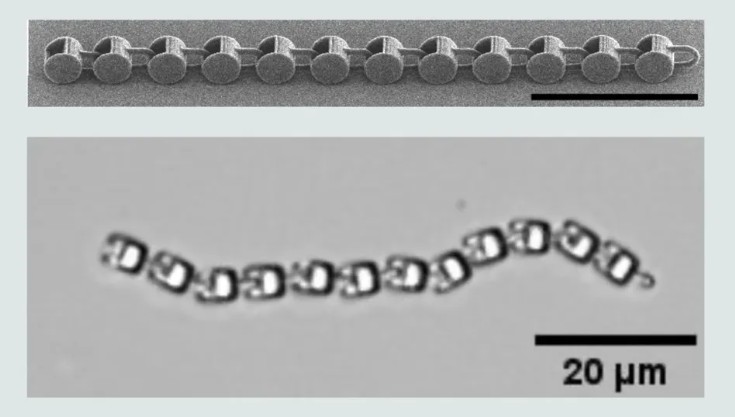
A breakthrough in microscale robotics is redefining what it means for machines to move intelligently. Researchers at Leiden University have developed 3D-printed robots as small as single-celled organisms, capable of motion without relying on traditional components such as motors, sensors, or processors. These microrobots, measuring between 0.5 and 5 micrometers, operate at the edge of current fabrication capabilities, tells Tom’s Hardware.
Unlike conventional robots that depend on electronic control systems, these devices move through a combination of physical design and environmental interaction. Their flexible, chain-like structures respond to external electric fields, bending and shifting shape in ways that generate propulsion. This creates a continuous feedback loop in which the robot’s form influences its movement, and its movement, in turn, alters its form.
The design draws inspiration from biological organisms such as worms and snakes, which adapt their bodies dynamically to navigate complex environments. By embedding this adaptability directly into the robot’s structure, researchers have eliminated the need for onboard intelligence. The result is behavior that appears lifelike, even though it emerges purely from physical interactions rather than computation.
These microrobots can even exhibit responsive behaviors under stress. When their motion is obstructed, they display tail-like movements as if attempting to free themselves, demonstrating how simple mechanical systems can produce complex, adaptive responses.
The potential applications are significant, particularly in medicine. Their small size and natural movement patterns make them promising candidates for targeted drug delivery, minimally invasive procedures, and diagnostic tasks within the human body. However, researchers note that the underlying mechanisms driving their motion are not yet fully understood, and further study is needed to unlock their full capabilities.
The work represents a shift in robotics design philosophy. Rather than adding intelligence through electronics, engineers are embedding it directly into materials and structures, opening new possibilities for autonomous behavior at microscopic scales.
