

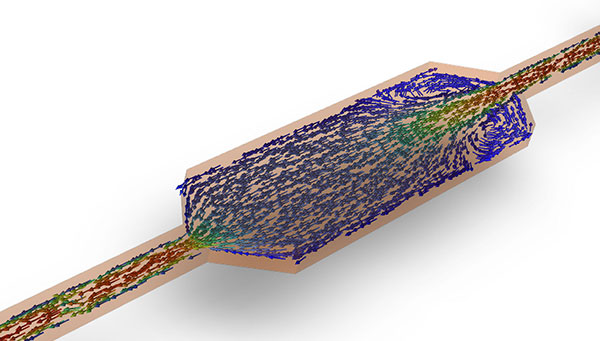
Microfluidic devices, i.e., tiny systems that shuttle and analyze minute volumes of fluids, are more than a tech novelty. They handle fluids at the edge of the continuum, where surface forces and particle behavior dominate, and conventional fluid dynamics begin to falter.
These microscale systems are governed by the same underlying equations as macro-scale flows, but the physics shifts. You’re no longer wrestling with turbulence; instead, capillary action, electrokinetics, and interfacial phenomena take the wheel, tells Digital Engineering.
So why does this matter? Microfluidic platforms power lab-on-a-chip and organ-on-a-chip technologies. These are compact, integrated tools that process fluids and perform lab-like analysis in a chip-sized package. They cut reagent use, shrink analysis time, boost throughput, and hold up well under low-volume, precise control scenarios.
Microfluidics also offers real-world applications such as:
- Diagnostics and point-of-care testing get a boost—lower sample needs, faster results, affordable, portable devices.
- Organ-on-a-chip systems simulate physiology realistically and hold promise as more ethical, efficient alternatives to animal models.
- In biotech and pharma, microfluidics enables rapid, high-resolution screening, targeted analysis, and automation—all in compact, scalable setups.
Microfluidic devices pack lab capabilities into palm-sized packages, delivering precision, speed, and cost-efficiency. And that’s why they’re quietly shaping the future of diagnostics, drug development, environmental sensing, and beyond.
