

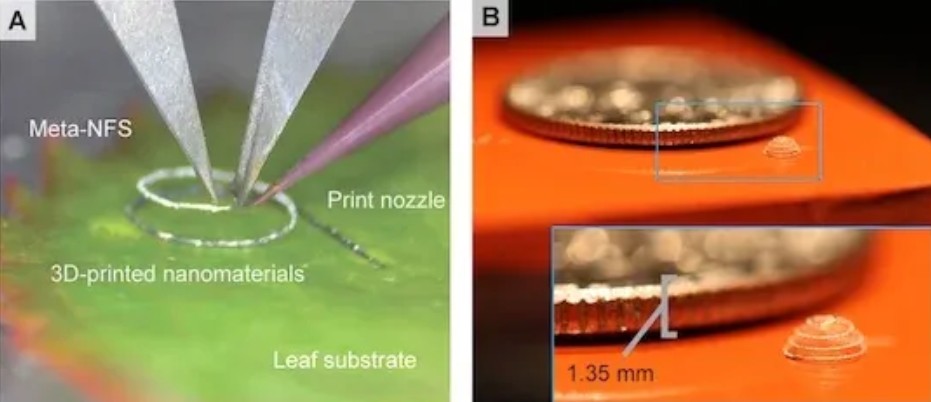
A new breakthrough in additive manufacturing is redefining what 3D printers can build, moving beyond structural parts into fully integrated electronic systems. Researchers have developed a technique that uses microwaves to heat 3D printer filament with extraordinary precision, enabling circuits to be fused directly inside printed objects rather than added afterward, tells Tom’s Hardware.
The innovation, known as a metamaterial-inspired near-field electromagnetic structure, allows microwaves to target extremely small regions, down to the width of a human hair. This level of control makes it possible to selectively heat nanoparticle inks embedded within a print, activating them without affecting the surrounding material. Unlike traditional methods such as lasers or furnaces, which heat from the outside in, this approach can penetrate layers and deliver energy internally.
This capability addresses a long-standing limitation in 3D printing. Conventional techniques struggle to integrate electronics within soft or complex materials because heating processes can damage outer layers or require post-processing steps. By contrast, microwave-based heating allows circuits to be formed in place during the printing process, enabling seamless integration of conductive pathways within the structure.
The system also expands the range of usable materials. Researchers demonstrated compatibility with metals, ceramics, and thermoset polymers, supporting multi-material printing in a single continuous operation. Real-time control over microwave power further improves efficiency, allowing precise adjustments during fabrication without interrupting the process.
Potential applications extend across multiple domains. The technique could enable soft robotics with embedded electronics, biocompatible implants with integrated sensors, and even devices that interact with living systems, such as sensors embedded in plants for monitoring growth. These examples highlight the technology’s ability to bridge mechanical structures and electronic functionality in ways previously unattainable.
The broader implication is a shift in additive manufacturing from assembling parts to fabricating fully functional systems. By combining precise energy delivery with material flexibility, microwave-assisted 3D printing opens the door to more complex, integrated devices, pointing toward a future where electronics are built directly into the objects they power.
