

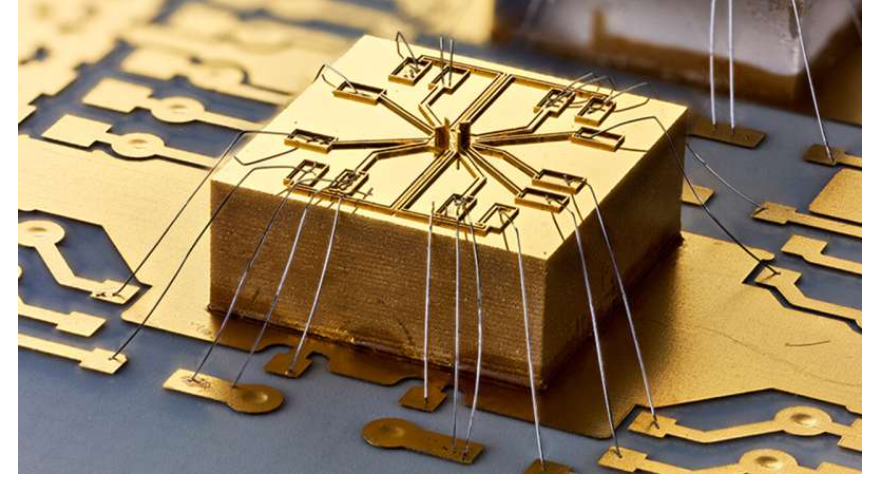
Researchers at Lawrence Livermore National Laboratory, UC Berkeley, UC Riverside, and UC Santa Barbara have achieved a milestone: they have produced miniaturized 3D ion traps using high-resolution 3D printing techniques that perform on par with conventional devices, tells Tech Xplore. Their method, two-photon polymerization (2PP), enables millimeter-scale quadrupole ion traps that can confine calcium ions while maintaining coherence, low error rates, and gate fidelities competitive with the best existing systems.
Traditional 2D “planar” ion trap designs scale well but suffer compromises in performance. Meanwhile, classic 3D trap geometries deliver better ion confinement but are hard to scale. The team’s innovation lies in combining the benefits: they can now 3D print complex ion trap geometries directly on a chip, giving tighter trapping potentials, higher frequencies, and more design flexibility. In tests, these traps successfully performed single- and two-qubit operations, and even executed a two-qubit entangling gate with a fidelity of 98%.
Beyond the quantum computation angle, the researchers highlight additional advantages of their approach. Their fabrication process allows rapid prototyping: a full trap can be printed from scratch in about 14 hours, or in 30 minutes if electrodes are printed onto an existing substrate. This speed and flexibility open doors to experimenting with new geometries, such as hybrid planar 3D designs, and integrating electronics and photonics directly on the chip.
Looking ahead, the team sees applications beyond quantum computing: precision sensing, compact atomic clocks, and miniaturized spectrometry systems could all benefit. Their work may also help address a major challenge in quantum systems, noise from trap surfaces, by reducing the material near the ions and enabling better control.
In short, this advance demonstrates that 3D-printed ion traps are not just a curiosity but a serious contender for scalable quantum hardware. It’s a significant step toward making complex ion trap systems more practical, customizable, and integrated.
