

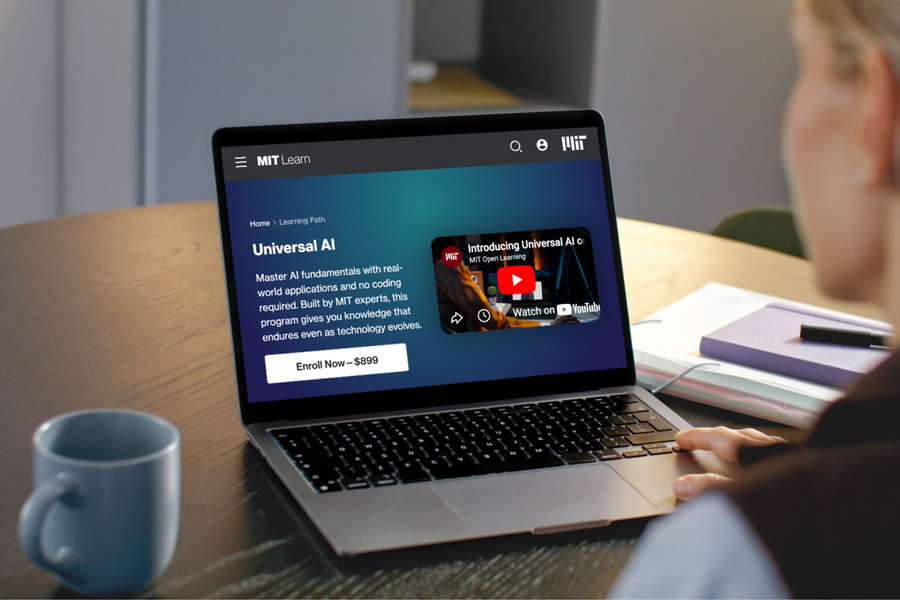
MIT Open Learning has launched a new educational initiative called Universal AI, an online program designed to make artificial intelligence education accessible to a much broader audience. Rather than targeting only engineers or computer scientists, the initiative focuses on helping learners from diverse professional and educational backgrounds develop practical AI fluency. The program reflects MIT’s view that artificial intelligence will increasingly shape nearly every industry and aspect of daily life, making foundational AI knowledge essential rather than optional.
The self-paced program combines foundational instruction with industry-specific applications. Learners begin with core concepts such as programming, machine learning, deep learning, explainability, ethics, and large language models before moving into specialized fields including health care, sustainability, entrepreneurship, and transportation. MIT has made the introductory course, Fundamentals of Programming and Machine Learning, freely available worldwide in an effort to lower barriers to entry.
A defining feature of Universal AI is its emphasis on accessibility and adaptability. MIT designed the curriculum specifically for nontechnical learners and global audiences, departing from the traditional model of simply repackaging university classroom material for online delivery. The courses are modular, asynchronous, and mobile-friendly, allowing students to progress at their own pace while tailoring learning paths to their interests and career goals.
The platform also integrates an AI-powered assistant called AskTIM, which functions as a digital tutor. The assistant helps learners navigate concepts, answer questions, reinforce coursework, and provide guidance during assignments. MIT positions the tool as a scalable alternative to traditional teaching support, offering personalized assistance to large numbers of online learners simultaneously.
The initiative signals a broader shift in higher education’s approach to AI literacy. MIT leaders argue that future workforce preparation requires interdisciplinary understanding rather than isolated technical specialization. By combining practical applications, flexible learning structures, and AI-assisted instruction, Universal AI attempts to bridge the widening gap between rapid technological change and public understanding. The program also demonstrates how universities are increasingly rethinking online education as a long-term infrastructure for global skill development rather than a supplemental learning experiment.
