

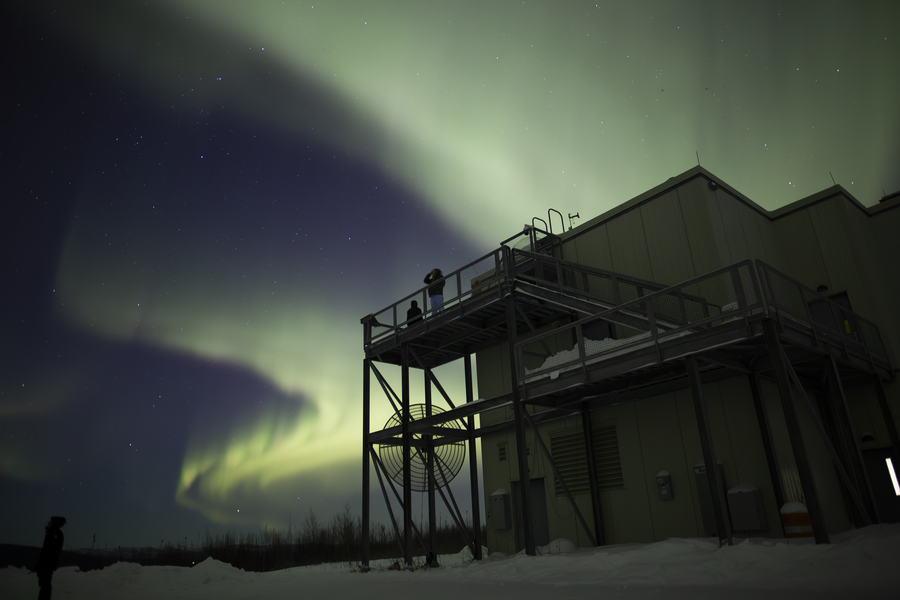
Students from Massachusetts Institute of Technology are traveling to Alaska to study the plasma physics hidden beneath Earth’s auroras, combining classroom theory with real-world scientific fieldwork. A recent article from MIT News describes how student-led expeditions organized through MIT’s Plasma Science and Fusion Center are helping young researchers investigate the complex interactions between charged particles, Earth’s magnetic field, and the atmosphere.
The expeditions focus on observing auroral structures created when energetic particles from space collide with gases in Earth’s upper atmosphere. These glowing formations are more than visual spectacles. They also act as natural laboratories for studying plasma, often called the fourth state of matter, which plays a central role in both astrophysics and fusion-energy research.
Students deployed distributed scientific instruments across Alaska to capture detailed measurements of auroral activity. According to the article, the research teams used cameras, sensors, and electromagnetic monitoring equipment to study the fine-scale behavior of plasma beneath the northern lights. By coordinating observations from multiple locations, the researchers aimed to better understand the physical processes driving auroral motion and energy transfer in near-Earth space.
The article emphasizes the educational value of the project as much as the science itself. Students were responsible for planning logistics, operating instruments in difficult field conditions, analyzing data, and adapting experiments in real time. Faculty members described the experience as an opportunity for participants to develop practical research skills rarely gained through traditional classroom instruction alone.
The work also connects directly to broader scientific goals. Understanding plasma behavior in Earth’s magnetosphere can improve models of space weather, which affects satellites, communications systems, and power infrastructure. The findings may also contribute to fusion-energy research, where controlling plasma remains one of the field’s central engineering challenges.
Beyond the technical research, the article portrays the Alaska expeditions as immersive scientific training experiences that expose students to the realities of experimental physics. By studying the aurora firsthand, participants gain insight into both the beauty and complexity of plasma processes occurring throughout the universe.
