

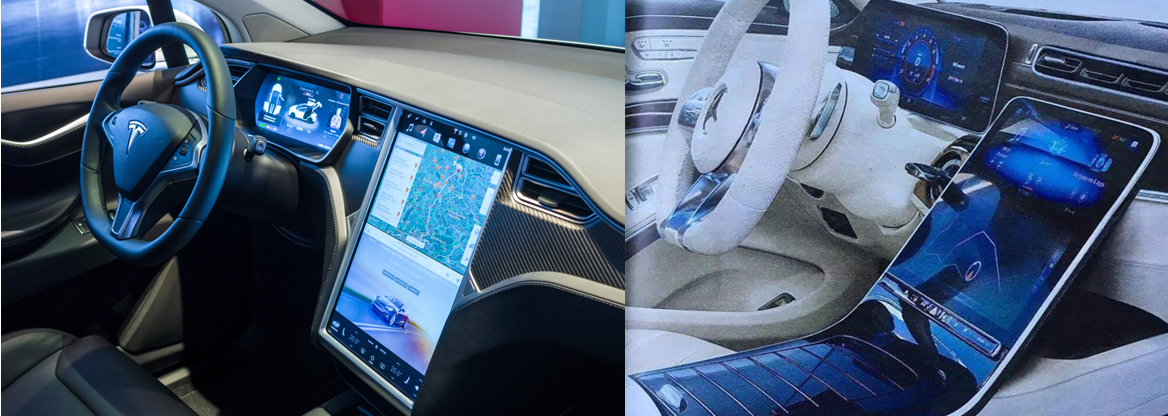
The modern automobile is undergoing a transformation as profound as the shift from horse-drawn carriages to combustion engines. At the center of this evolution is the software-defined vehicle—a concept that reimagines the car not just as a machine of metal and mechanics, but as a vehicle driven by code.
For proof, look no further than the screen found in many modern car interiors, either in place of a dashboard (Tesla) or an addition to it (Mercedes). The touch-sensitive screens in some vehicles are as large as the biggest iPads. Driving one of these vehicles gives the distinct feeling that you are driving the computer around. Turn on the self-driving features and it’s the computers that are driving the car around.
Unlike vehicles in the not-too-distant past, where software was merely an add-on to support hardware functions, the software-defined vehicle places software at the core of vehicle design, performance, and user experience. From the way a car accelerates or brakes, to its infotainment systems, safety features, and autonomous capabilities, is all driven by software. Therefore, it is software that has become the crux of the design effort.
A modern vehicle may be more or less a computer on wheels, but it has a few operational challenges. Your computer’s size makes it much more manageable. It doesn’t weigh several tons. It stays still and does not approach the death-defying speed of a vehicle. You don’t get liability insurance on your laptop, whereas the potential for damage a car can cause is ridiculous.
Because of all the risks and complexity, the software and hardware are much more critical, and the design of these components in a vehicle has to be more accountable and dependable. The software can’t have glitches or crashes. The blue screen of death, annoying in an office, could literally mean death on the road. The operating environment is a whole other story. Your laptop only has to function at regulated indoor temperatures. Its screen only needs to be visible under controlled artificial light. Your vehicle, on the other hand, must contend with extremes of the environment, including the poles to the equator. My devices, by comparison, live the pampered life. They refuse to operate if the temperature gets too hot for them inside my car — which it often does when left behind in California’s summers.
Chicken or Egg
The convergence of accelerated design cycles and deepening vehicle computerization has created a fundamental dilemma for automakers: should the software be developed first, or should the hardware? In the era of the software-defined vehicle (SDV), this so-called chicken-or-the-egg problem is becoming more acute. Traditionally, semiconductor design came first, with software developed later to run on fixed hardware specifications. But modern automotive software is far too complex—and too critical to safety and performance—for that approach to remain viable.

David Fritz, VP of Virtual and Hybrid Systems at Siemens, puts it succinctly: “We have to break this whole concept of a catch-22 whereby, how do you develop the software when there’s no hardware, and then how do you develop hardware to support the software when the software doesn’t exist yet?” The solution, he explains, lies in co-developing both elements simultaneously, supported by virtual models and digital twins. This approach not only breaks the cycle but allows developers to identify performance, safety, and integration issues earlier—helping automakers avoid costly redesigns and recalls down the line.

“Every automotive OEM over the last 100 years has developed their automotive ecosystem with their set of suppliers,” says Michael Severson, Senior Automotive Marketing Manager for Siemens Digital Industries Software, with nearly 15 years with Ford Motor Company. “These complex systems were divided among the Tier One and Tier Two suppliers, and they each developed a piece of the whole vehicle. Then they would put it all together, but nothing worked. We called that the “integration storm,” and that could account for as much as 50% of the total calendar time of a new vehicle.”
Enter the Digital Twin
This shift is forcing automakers to rethink how they build cars. Mechanical systems, electronics, and software must now be engineered together in a coordinated, iterative process. It’s no longer enough to build the hardware first and integrate the software later. Instead, hardware and software are now developed simultaneously, each influencing the other from the earliest stages of design.
Digital twins are emerging as a critical tool in solving the timing mismatch between software and hardware development in automotive programs. These virtual representations of hardware systems—ranging from individual semiconductors to full vehicle architectures—allow software teams to begin development and validation long before the physical hardware is available. This bridges the gap and effectively eliminates the “which comes first?” problem.

“In the software-defined world, [automakers] have to focus not only on the vehicle architecture, but also on the electrical/electronics architecture and the software architecture,” says Nand Kochlar, vice president of Automotive and Transportation Industry Strategy for Siemens Digital Industries. “You have to think of all of these simultaneously, and you have to do the optimization at the architecture level, up front.”
By simulating processor behavior, memory usage, thermal profiles, and more, digital twins give developers a high-fidelity environment where software workloads can be tested under real-world conditions.
“We need to create a virtual environment where the software team could start actually running the software long before there is anything tangible on the semiconductor side to start verifying against,” explains Fritz. These models evolve, increasing in accuracy as both software and hardware specifications are refined in tandem.

“We have to rethink the way that we do the entire system-level design,” said Michael Munsey, Vice President of Electronics & Semiconductors for Siemens Digital Industries Software. “The big change is we’re now doing software and semiconductor at the same time.”
The result is a far more iterative and integrated development process. Design trade-offs—such as computational load balancing, safety-critical timing margins, and power efficiency—can be evaluated early, rather than discovered during late-stage integration. And when the real silicon finally arrives, much of the software is already production-ready, cutting down on costly delays and enabling faster, more reliable vehicle launches.
The implications are enormous. Automakers must adopt agile software practices, develop digital twins to simulate entire vehicle systems, and retool their supply chains—breaking down long-standing silos between mechanical, electrical, and software engineering.
_________________________
Source: Defining the Software-defined Vehicle – Ep. 6 of On the Move: A Siemens Automotive Podcast.
