

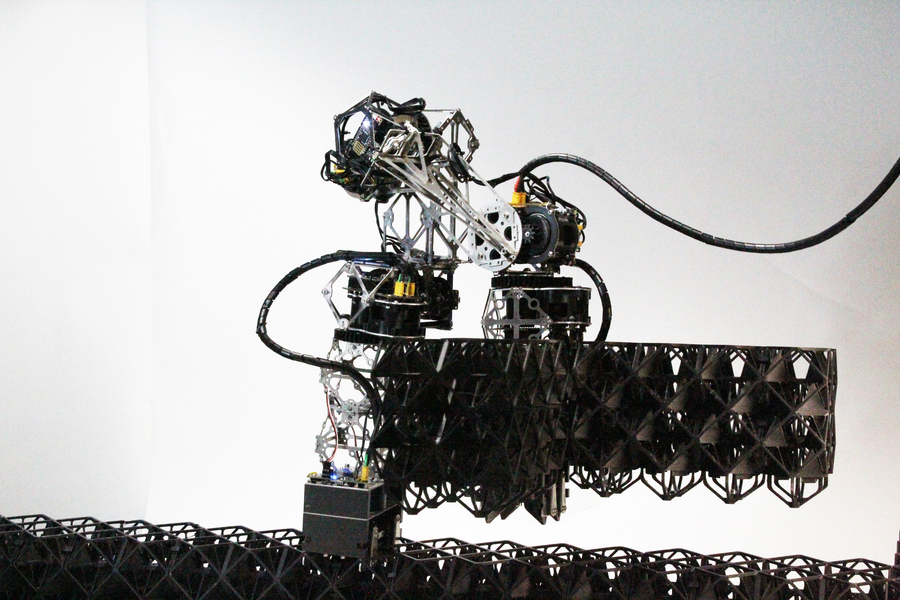
MIT researchers are exploring a new construction paradigm built around robotically assembled modular units, or “voxels,” that could significantly improve efficiency and sustainability in the built environment, tells MIT News. The study evaluates whether structures assembled from these standardized building blocks can compete with conventional methods such as concrete, steel framing, and 3D printing.
Voxels are small, repeatable 3D subunits that can be combined into larger, load-bearing structures. Unlike traditional construction materials, these components are designed for robotic assembly, allowing automated systems to build structures piece by piece with precision. The researchers developed new voxel geometries that mechanically self-align, enabling robots to connect them through simple snap-fit mechanisms.
The system relies on specialized robots that move across a structure while placing and attaching voxels. Because the units are lightweight and standardized, multiple robots can work in parallel, increasing construction speed. In simulations, teams of robots were able to match or outperform traditional construction methods in both cost and build time when scaled appropriately.
One of the most significant findings relates to environmental impact. Depending on the material used, voxel-based construction could reduce embodied carbon dramatically, with some configurations achieving reductions of up to 82% compared to conventional techniques. This is particularly relevant as the construction sector faces increasing pressure to lower emissions and adopt more sustainable practices.
Another advantage is reversibility. Structures built from voxels can be disassembled and reconfigured, allowing materials to be reused rather than discarded. This introduces a circular approach to construction, where buildings can evolve over time instead of being demolished and rebuilt.
While still in the research phase, the concept points toward a future where buildings are assembled more like products than one-off projects. By combining robotics, modular design, and scalable manufacturing principles, the approach could reshape construction into a more efficient, adaptable, and environmentally responsible industry.
