

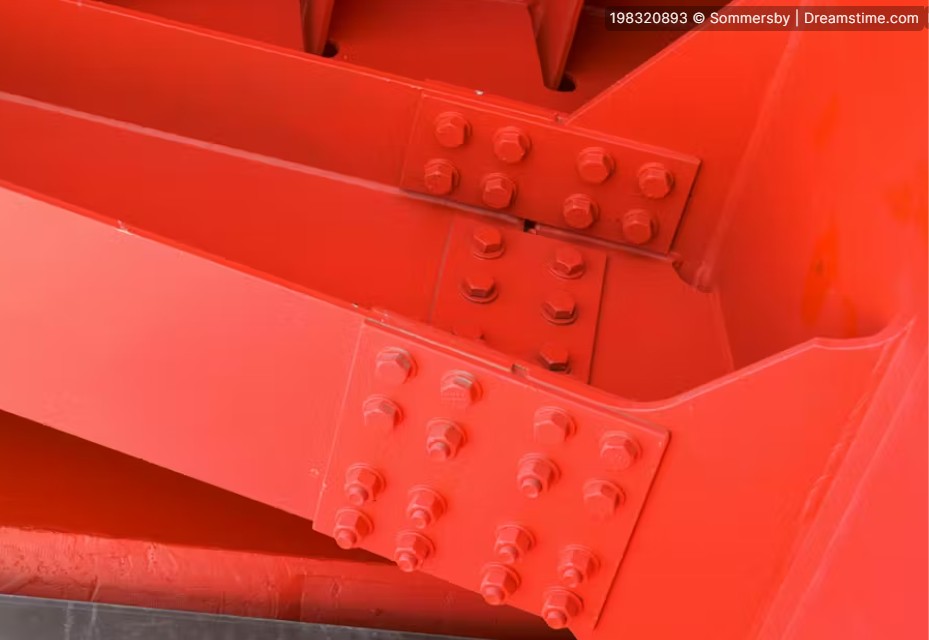
Machine Design published a technical article on a validated analytical method for estimating moment stiffness in bolted connections, an aspect of joint behavior that often gets overlooked in engineering practice. Designers typically focus on axial stiffness and preload selection because those are well-covered in handbooks and calculators, but precision machines seldom experience purely axial loads. Real-world systems see combined axial, shear, and especially moment (pitch) loads due to geometry and force offsets, and these can dominate joint compliance and affect positioning accuracy and dynamics.
The authors, Akshay Dipakkumar Harlalka and Alexander H. Slocum, note that under moment loading, the strain in a bolted joint becomes asymmetric. One side of the interface compresses while the opposite side unloads, creating a nonuniform pressure distribution at the interface. Recognizing this difference is key to estimating joint stiffness under moment loads.
Their analytical model captures bolt elasticity, member deformation, preload distribution, and external constraints. It predicts rotational stiffness (pitch moment stiffness) for bolted interfaces such as bearing support blocks used in precision motion systems. This model aligns well with finite element analysis and experiments for typical 2-bolt and 4-bolt patterns. Importantly, the moment stiffness can be derived from the axial stiffness and the effective width of the interface resisting rotation, making the approach more accessible to design engineers who already account for axial behavior.
The article also lists design recommendations to improve moment stiffness without unnecessary increases in preload or mass. These include increasing joint width, spacing bolts farther from the neutral axis, accounting for member compliance, selecting appropriate housing materials, and minimizing load height above the interface. Early inclusion of moment stiffness in system accuracy budgets helps avoid late-stage redesign and unexpected compliance issues.
