

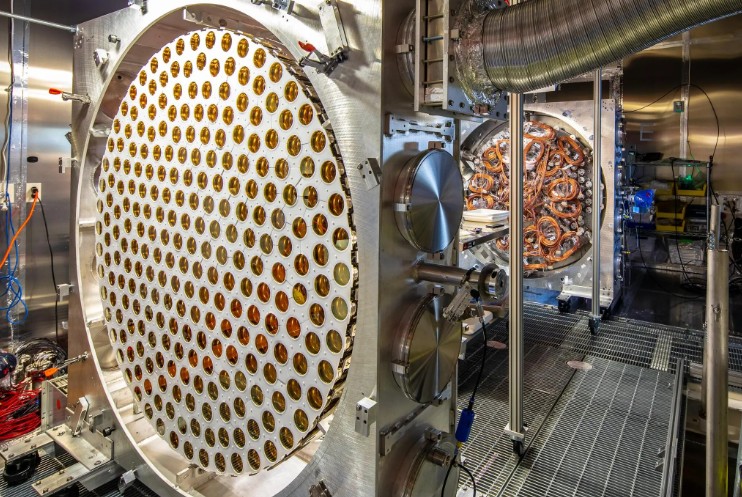
After decades of searching for dark matter without directly detecting it, physicists working on the LZ Dark Matter Experiment have found an unusual signal that they cannot readily explain. The single particle interaction is intriguing because it does not fit the expected behavior of other known particles, although researchers stress that it is far too early to call it a dark matter discovery, tells The New York Times.
Dark matter is thought to account for about 85% of the matter in the universe. It neither emits nor reflects light, so scientists infer its existence largely from its gravitational effects on galaxies and stars. One leading candidate is the weakly interacting massive particle, or WIMP, a hypothetical particle that could occasionally collide with ordinary atomic nuclei.
The LZ experiment searches for such collisions using more than seven tons of liquid xenon inside a detector located nearly a mile underground at the Sanford Underground Research Facility in South Dakota. The depth helps shield the experiment from cosmic radiation, while surrounding water and highly purified xenon reduce other sources of interference.
Researchers examined 220 days of data, initially searching for interactions predicted by simpler WIMP theories. After finding nothing, they broadened the analysis to include more complex possibilities. One event remained. Recorded on June 16, 2023, it involved a particle striking the nucleus of a xenon atom and producing detectable light and electrical charge.
The event has a statistical significance of about 3 sigma, corresponding to roughly a 1-in-400 probability of being a fluke. Particle physicists generally require 5 sigma before declaring a discovery.
Researchers also acknowledge that an unknown interaction involving ordinary matter could explain the signal. More evidence should soon help clarify the mystery. LZ has already collected nearly four times as much data as was included in this analysis, while similar liquid-xenon experiments in Italy and China could provide independent evidence.
For now, the unexplained interaction represents an intriguing clue rather than proof that scientists have finally detected dark matter.
