

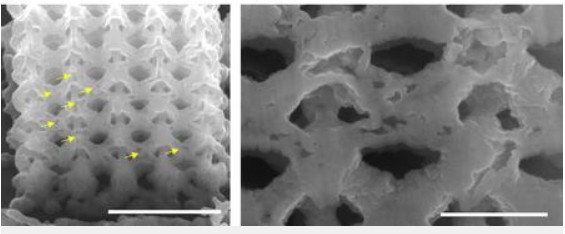
Scientists at the California Institute of Technology have developed a method to engineer extremely small three-dimensional metallic components at the nanoscale, offering a new way to rethink how metals behave under extreme miniaturization. The research demonstrates that tiny metal structures, even those filled with pores and irregularities, can exhibit remarkable strength rather than weakness.
The process enables the creation of complex 3D metal parts using a technique that can be applied to a wide range of metals and alloys. Unlike conventional manufacturing, where defects such as porosity typically degrade performance, the Caltech team found that these “imperfections” can actually enhance mechanical properties at very small scales. At the nanoscale, deformation mechanisms behave differently, allowing the material to distribute stress more effectively and resist failure.
A key insight from the research is that size fundamentally changes material behavior. In larger structures, defects act as weak points that lead to cracking or failure. However, in nanoscale architectures, these same features interrupt the movement of dislocations, preventing damage from propagating through the material. This results in components that are both lightweight and surprisingly strong, despite their seemingly disordered internal structure.
The ability to precisely engineer such structures opens up a range of potential applications. These include advanced microelectronics, where compact and durable components are critical; medical devices that require fine-scale precision; and aerospace systems, where weight reduction without sacrificing strength is essential. The flexibility of the method also allows engineers to tailor properties by adjusting composition and geometry at extremely small scales.
This work challenges long-standing assumptions in materials science, particularly the idea that defects are inherently detrimental. Instead, it suggests that controlled disorder, when engineered at the nanoscale, can be a powerful tool for designing next-generation materials with enhanced performance.
