

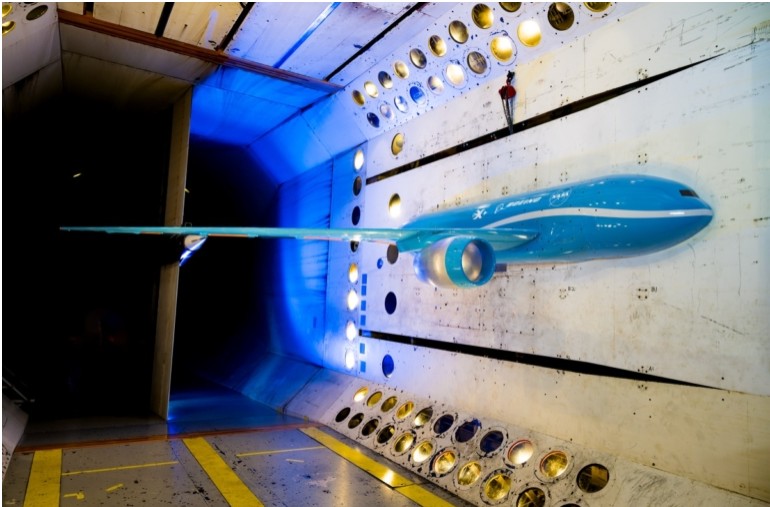
NASA and Boeing are deep into research on long, slender wings that could shape future commercial aircraft with greater efficiency and smoother rides. Those high-aspect-ratio wings, much longer and narrower than today’s designs, promise reduced aerodynamic drag and lower fuel use as airlines face pressure to cut emissions and operating costs. But that geometry also brings challenges in structural behavior that engineers must solve before flight-ready designs emerge, tells Aerospace Global News.
Longer, thinner wings tend to bend and vibrate more in flight, especially under gusts and during maneuvers. That phenomenon, known as wing flutter, can compromise safety if not controlled. To address this, the partners developed the Integrated Adaptive Wing Technology Maturation program to explore active control techniques that damp unwanted motions while preserving the efficiency gains.
Testing took place in NASA’s Transonic Dynamics Tunnel, one of the few facilities capable of handling large-scale aerodynamic models with realistic airflow. Researchers built a detailed half-aircraft model with a 13-foot wing and 10 movable control surfaces along its trailing edge. During wind-tunnel runs, sensors captured aerodynamic forces and structural responses as engineers adjusted the control surfaces to manage airflow and reduce wing motion. Initial results show that these adaptive controls significantly reduced movement during simulated gusts, pointing to practical ways of managing aeroelastic behavior in future planes.
The work builds on earlier adaptive wing concepts but pushes active control farther by increasing the number of adjustable surfaces and control strategies. Engineers say the data from these experiments will guide aircraft makers in deciding which technologies are ready to move beyond research into real-world applications.
For airlines and passengers, success could bring jets that fly farther with less fuel, deliver a smoother ride through turbulence, and help meet stringent efficiency and environmental targets. Ongoing analysis and sharing of results with the aviation industry will determine how quickly these innovations transition from wind-tunnel models to next-generation airliners.
