

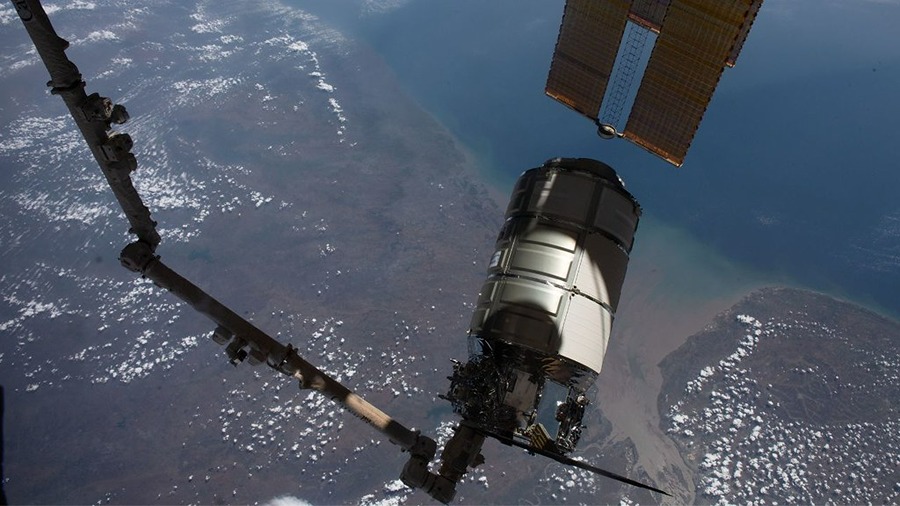
Media credit: NASA
KENNEDY SPACE CENTER, FL, Sep 15, 2025 – On Sep 14, NASA’s Northrop Grumman commercial resupply services (CRS) 23 mission launched on a SpaceX Falcon 9 rocket from Cape Canaveral Space Force Station, carrying more than 15 International Space Station (ISS) national laboratory-sponsored investigations. The projects aim to improve medicine production, make orbital paths safer, and enhance technology used in television, computer, and smartphones. Supported by the ISS crew, these projects could shape the future low Earth orbit economy (LEO).
Below highlights some of the projects launching on this mission.
- Arizona State University, in collaboration with BioServe Space Technologies, will examine how germicidal ultraviolet light delivered through optical fibers could inhibit the formation of harmful biofilms in water systems. The U.S. National Science Foundation is funding the project to develop a cost-effective alternative to conventional disinfectants. The results could support spacecraft life support systems and improve drinking water treatment on Earth.
- Revolution Space will test the performance and safety of an electric propulsion system in LEO. The new technology could provide a solution to maneuver spacecraft and satellites.
- Bristol Myers Squibb is conducting crystal growth experiments using Redwire Space’s pharma lab. The crystals produced in microgravity can be used to improve the formulation and production of medications on Earth.
- TransAstra Corp. will utilize Voyager Space’s Bishop Airlock to test the deployment of an inflatable Capture Bag system, an affordable solution to space debris collection. In a LEO economy, the ability to capture and control space debris will be necessary to make the orbit around Earth safer for astronauts, satellites, and spacecraft.
- Voyager Technologies will use its LEOcloud Space Edge to demonstrate cloud computing infrastructure and test its connection with terrestrial networks. The project will evaluate processing data in space at speeds suitable for research. It may inform future work in human spaceflight, microgravity research, Earth observation, lunar missions, and national security. Sierra Space served as the implementation partner for this project.
- In partnership with Voyager Technologies, Thailand will launch its first investigation to the space station. Researchers from Kasetsart University will study liquid crystal films in microgravity. The results could support the development of liquid crystal display (LCD) technology in computer screens and smartphones on Earth and in space.
Source: ISS
About International Space Station (ISS) National Laboratory

The International Space Station is an orbiting laboratory that enables research and technology development not possible on Earth. Operated as a public service, the ISS National Laboratory allows U.S. government agencies, academic institutions, and private-sector organizations to access its microgravity environment, Earth observation capabilities, and space-based conditions to support non-NASA science, technology, and education initiatives. The lab promotes research aimed at improving life on Earth, supporting the growth of commercial space activity, and advancing STEM education. Established in 2005, the ISS National Laboratory has been managed by the nonprofit Center for the Advancement of Science in Space (CASIS), since 2011 under a cooperative agreement with NASA. Headquartered in Rockledge, FL, the lab has supported more than 700 research payloads. In fiscal year 2024, it sponsored over 100 experiments, nearly 80% from commercial users. That year, funding commitments totaled nearly $25M, with STEM outreach and over 50 publications.
About Northrop Grumman

Northrop Grumman is an American aerospace and defense technology company that provides systems, products, and solutions in autonomous systems, cyber, C4ISR, space, strike, and logistics. Founded in 1994 through the acquisition of Grumman Corporation by Northrop Corporation, the company has a legacy in military and space technologies. Northrop Grumman serves various industries, primarily defense and government, supporting the U.S. Department of Defense, NASA, and allied nations with mission-critical systems such as B-21 Raider bombers, Global Hawk unmanned systems, and missile defense technologies. It also plays a key role in cybersecurity and intelligence solutions. As of 2024, the company reports annual revenue of approximately $40B and employs over 90,000 people worldwide. Headquartered in Falls Church, VA, Northrop Grumman has a global footprint with engineering and manufacturing facilities across the United States and international markets.
