

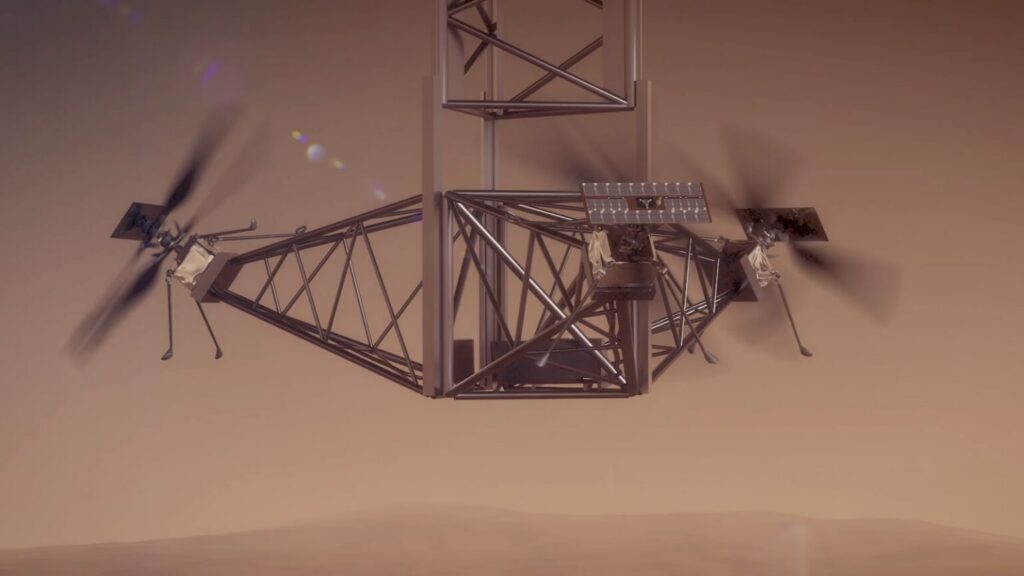
Engineers at NASA Jet Propulsion Laboratory have achieved a major milestone in rotor technology that could dramatically expand the future of aerial exploration on Mars. The Ars Technica article explains how researchers successfully tested helicopter rotor blades at supersonic tip speeds under simulated Martian conditions without the blades breaking apart, overcoming one of the biggest obstacles facing next-generation Mars aircraft.
The breakthrough builds on the success of the Ingenuity Mars Helicopter, the small experimental helicopter that completed 72 flights on Mars after arriving with the Perseverance rover in 2021. Ingenuity proved that powered flight was possible in the planet’s extremely thin atmosphere, but its small size severely limited payload capacity. Future missions aim to carry heavier scientific instruments, improved communications systems, and larger batteries for longer-range exploration.
To achieve this, NASA and aerospace company AeroVironment developed new rotor systems capable of spinning far faster than conventional helicopter blades on Earth. During testing inside JPL’s 25-Foot Space Simulator, engineers pushed rotor tip speeds to Mach 1.08, exceeding the speed of sound in Mars’ low-density atmosphere. The tests involved both two-bladed and three-bladed rotor designs operating at rotational speeds approaching 3,750 revolutions per minute.
The article explains that operating at these extreme speeds introduces severe aerodynamic and structural stresses. Rotor blades risk instability, vibration, and material failure as shock waves form near the blade tips. Engineers spent years refining blade geometry, materials, and aerodynamic behavior to survive the harsh conditions while still generating enough lift. According to NASA researchers, the new designs increased lifting capability by roughly 30% compared with earlier systems.
The technology is expected to support NASA’s proposed SkyFall mission, which could deploy multiple advanced helicopters across Mars later this decade. Unlike Ingenuity, these aircraft would function as genuine scientific explorers capable of reaching terrain inaccessible to rovers. The article presents the breakthrough as a crucial step toward transforming aerial mobility into a permanent tool for planetary exploration.
