

SUNNYVALE, CA, Apr 17, 2026 – NASA selected Synopsys and EMA to verify Artemis spacesuit performance under lunar environmental conditions. The work evaluates how spacesuits behave under charging effects during extravehicular activity. It also supports Artemis mission planning and complements a separate effort with Cesium and Glenn Research Center to assess cellular system performance on the Moon using digital twin.
The joint work by EMA and Synopsys focuses on risks from triboelectrification caused by interactions with lunar regolith and electrical charging in the space plasma environment. These conditions can lead to electrostatic discharge (ESD). ESD events can damage electronics used for communications and life support in multi-layer spacesuits, making charging analysis critical for lunar operations.
EMA and Synopsys will apply physics-based workflows using Ansys Charge Plus to simulate electromagnetic charging and discharging. The software evaluates spacesuit materials, layered stack-ups, and representative suit features under lunar plasma conditions. Charge Plus models plasma interaction, surface charging, charge transport, and ESD in multi-material systems using 3D computation.
Simulation work is paired with testing at EMA’s Space Environment and Radiation Effects (SERE) Lab in Pittsfield, Massachusetts. The facility replicates key aspects of the space plasma environment. This combined simulation and test workflow helps identify charging drivers, evaluate design tradeoffs, and focus validation on areas that affect astronaut safety and system performance.
“We’re honored to support NASA’s Johnson Space Center as they advance EVA readiness for Artemis,” said Justin McKennon, CTO of EMA. “By pairing test-informed data with simulation workflows, we can help identify worst-case charging conditions, evaluate material stack-ups, and target validation where it matters most.”
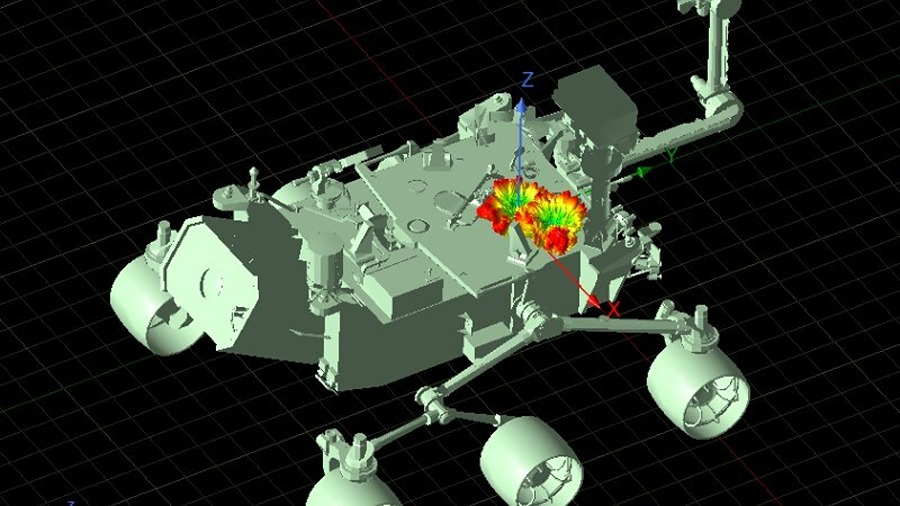
In addition to spacesuit validation, Cesium integrates 3D spatial data and Moon topography data into Synopsys’ digital mission engineering environment. The setup uses Ansys RF Channel Modeler to analyze radio frequency signal propagation. Ansys HFSS is also used to simulate antenna performance on spacesuits and rovers, supporting end-to-end connectivity analysis across the lunar surface.
“To build a lunar network, you must first build a digital moon,” said Patrick Cozzi, chief platform officer, Bentley Systems. “Cesium’s high-fidelity digital twin provides a virtual stage to test how communication signals perform against complex lunar topography, validating network reliability and ensuring mission-critical connectivity before hardware is deployed.”
The Lunar 3GPP team at NASA’s Glenn Research Center leverages this solution to visualize and validate RF coverage in the context of realistic operating scenarios. The insights can help inform radio placement that will enable connectivity outside of a future Moon Base. It will also support mission planning by identifying potential “shadow zones” caused by geographical elements on the Moon, like craters and rock formations that astronauts and rovers should avoid.
The Lunar 3GPP team at Glenn Research Center uses this approach to visualize and validate RF coverage under realistic operating scenarios. The analysis identifies signal “shadow zones” caused by terrain features such as craters and rock formations. These insights guide radio placement for future lunar missions and support planning for connectivity outside a potential Moon base.
“The Artemis program is an ambitious, collective effort to return humans to the Moon and establish a sustained presence as a foundation for future exploration,” said Jim Bridenstine, former NASA administrator and current advisor for AGI, part of Synopsys. “As we move further into the unforgiving and promising environment of space, we need to innovate quickly, boldly, and effectively. Embracing digital engineering technologies that enable teams to model, test, and refine designs virtually before hardware is built, is an important step to reducing risk and accelerating innovation.”
Source: Synopsys
About Synopsys

Synopsys Inc. is a U.S. software and semiconductor technology company founded in 1986. The company develops electronic design automation software, semiconductor intellectual property, and verification tools used to design and test integrated circuits. Its products help engineers design, simulate, verify, and manage semiconductor chips and electronic systems. Synopsys also provides software security testing and engineering analysis tools through internal development and acquisitions. The company serves semiconductor manufacturers, electronics companies, system integrators, and software developers. Its customers operate in industries such as semiconductors, automotive, aerospace, consumer electronics, telecommunications, and data centers. Synopsys is headquartered in Sunnyvale, CA. The company employs about 28,000 people worldwide and serves customers across global technology sectors. Synopsys operates offices across North America, Europe, and Asia.
About EMA

EMA is an engineering company that develops electromagnetic simulation software, testing services, and consulting for product design and certification. Founded in 1978, it is headquartered in Lakewood, CO. The company provides tools such as EMA3D and Ansys EMC Plus to model electromagnetic effects, including lightning, HIRF, EMC, and space plasma environments. Its software simulates coupling in cables and systems and analyzes charging, arcing, and interference behavior. EMA also conducts measurement, testing, and engineering consulting to validate designs and support compliance. It serves aerospace, defense, automotive, electronics, and energy industries. The company operates facilities in Colorado and Massachusetts and supports global engineering programs.
