

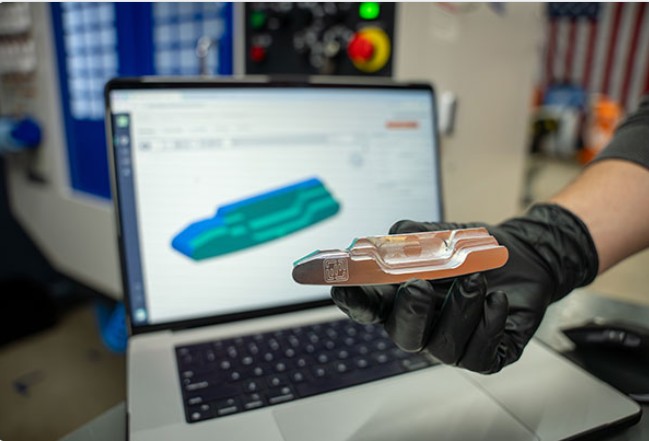
Engineering workflows in additive manufacturing and CNC machining have long depended on specialized software, coding expertise, and steep learning curves. The Digital Engineering 24/7 article explores a shift toward natural language interfaces powered by large language models, which could fundamentally change how engineers interact with these systems.
Instead of navigating complex CAD or CAM tools, engineers may increasingly describe design intent, constraints, or manufacturing goals in plain language. AI systems can then interpret these inputs and translate them into geometry, toolpaths, or machine instructions. This approach reduces reliance on deep software expertise and opens advanced manufacturing capabilities to a broader range of users.
In design for additive manufacturing, natural language input can accelerate early-stage design. Engineers could request optimized structures, material suggestions, or manufacturability feedback in real time. By embedding domain knowledge into AI systems, the process becomes more iterative and responsive, enabling faster exploration of design alternatives without switching between multiple tools.
For CNC machining, the implications are equally significant. Natural language prompts could generate machine-readable code, reducing manual programming effort and minimizing errors, particularly in complex multi-axis operations. This could automate routine programming tasks and allow engineers to focus more on design intent and process strategy rather than syntax and tool-specific commands.
Despite these advantages, limitations remain. Current AI systems still struggle with precise geometric reasoning and may require human oversight to ensure accuracy, safety, and manufacturability. Integration with existing CAD/CAM ecosystems also presents technical challenges, as workflows must adapt to accommodate AI-driven inputs.
The broader impact lies in accessibility and speed. By translating human intent directly into executable workflows, natural language interfaces could shorten design cycles, support rapid prototyping, and enable more customized production. Industries adopting these tools may see reduced complexity and faster iteration.
The article ultimately frames this transition as a shift in interaction, moving from tool-driven processes to intent-driven systems. While still evolving, natural language input signals a more intuitive and adaptive future for digital manufacturing.
