

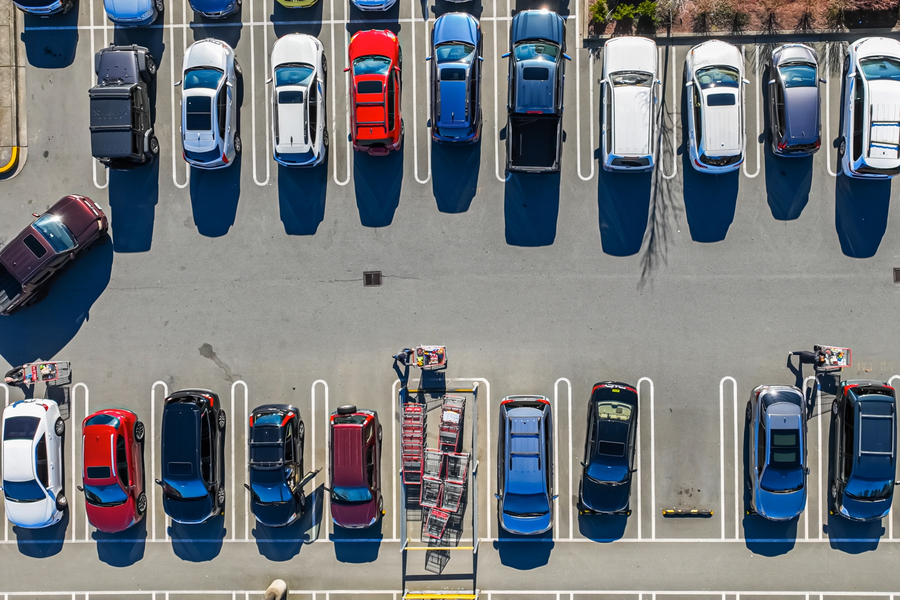
Researchers at the Massachusetts Institute of Technology have developed a navigation approach that accounts for the real cost of parking, not just the drive to a destination. Most navigation apps send drivers straight to their endpoint without considering how long it takes to find a space. This oversight leads to drivers circling lots, adding minutes to trips, worsening urban congestion, and increasing vehicle emissions. In tests with real traffic data, the new system cut total travel time as much as 66% in high-congestion scenarios, equivalent to saving about 35 minutes compared with conventional routing.
The key innovation is a probability-aware model that predicts both where parking is likely to be available and how far drivers will walk from each lot to their actual destination. It balances several factors: the distance to drive, chances of finding a space, and proximity to the endpoint. The system doesn’t just choose the closest lot. It may steer a driver to a slightly farther lot if the chances of success and shorter total trip time justify it. Importantly, the model also anticipates the behavior of other drivers, including competition for spaces, when calculating probabilities.
The algorithm uses dynamic programming to work backward from the best outcomes, considering what happens if the ideal lot is full and where to go next. Although the work is still in a research stage and not yet deployed in a commercial app, the results suggest this logic could be integrated into navigation services in the future.
Data on parking availability could come from dedicated sensors in lots where they exist, but the researchers see value in crowdsourced information from drivers or vehicle systems reporting open spaces. Their simulations indicate that crowdsourced data with a modest error rate still sharply improves route decisions and reduces needless cruising.
By offering more realistic travel estimates and reducing the time drivers spend hunting for spaces, parking-aware routing could ease urban traffic flows and cut emissions, while giving people clearer choices between driving and other modes of transport.
