

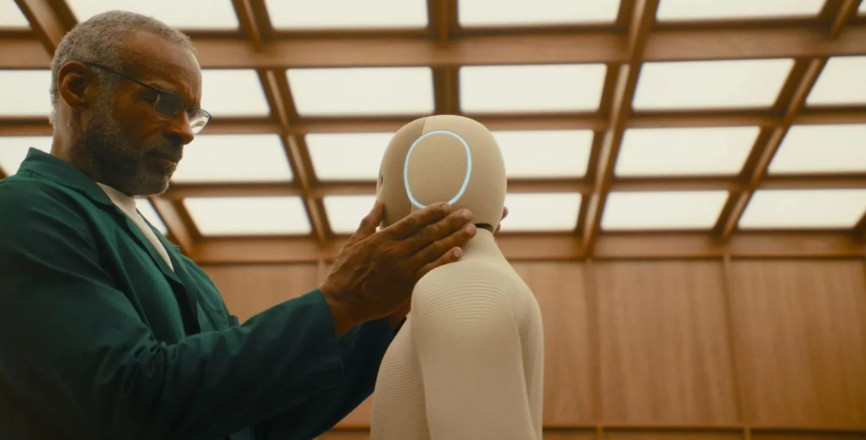
Silicon Valley–based robotics company 1X has entered a new phase in humanoid robotics by launching full-scale production of its Neo robot, marking a transition from experimental prototypes to industrial manufacturing. The Forbes article reports that the company has begun operations at its NEO Factory in Hayward, California, a 58,000-square-foot facility employing more than 200 workers and designed for high-volume output.
Neo is positioned as a home-focused humanoid robot capable of performing everyday tasks, from cleaning to basic assistance. The company has already demonstrated strong early demand, securing roughly 10,000 preorders within just five days of opening reservations. 1X aims to begin shipping units before the end of 2026, reinforcing the idea that humanoid robots are moving closer to mainstream adoption.
The production ramp is only the beginning of a broader scaling strategy. 1X plans to expand capacity further with an additional facility in San Carlos and increased automation across its manufacturing processes. These steps are expected to boost output dramatically, with a long-term goal of producing up to 100,000 humanoid robots annually by 2027.
This shift toward mass production reflects a larger inflection point in robotics. Advances in artificial intelligence, declining hardware costs, and growing investor interest are converging to make physically embodied AI systems more economically viable. Neo is part of a new generation of humanoid robots aimed at consumer environments rather than industrial settings, expanding the scope of where such machines can operate.
However, the broader context remains complex. While manufacturing readiness is improving, real-world performance still lags behind expectations, particularly in unstructured home environments. The success of Neo will depend not only on production scale but also on its ability to deliver reliable, autonomous functionality in everyday settings.
Even so, the move into full-scale manufacturing signals that humanoid robotics is no longer confined to labs and demos. It is entering a phase where production, distribution, and real-world use will define the next chapter.
