

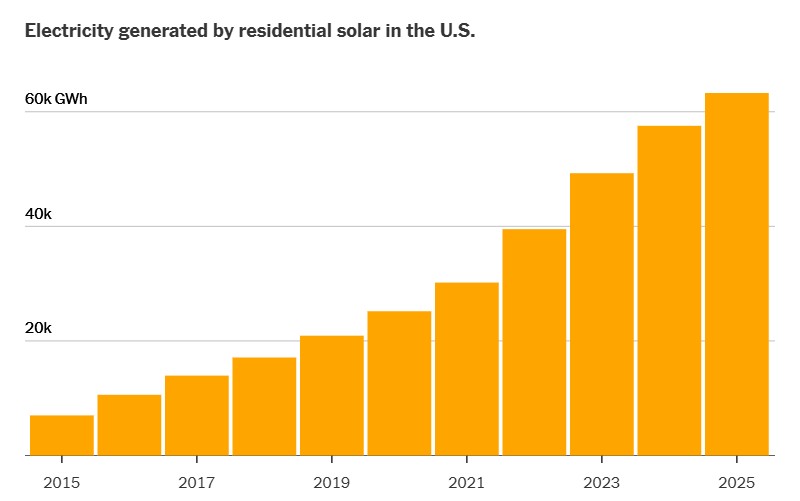
For years, rooftop solar has offered homeowners a straightforward financial proposition: generate electricity during the day, send excess power to the grid, and receive credits that offset electricity used at night. That equation is changing rapidly across the United States. While the end of the federal residential solar tax credit under the Trump administration has added new financial pressure, a more significant shift has come from states replacing traditional net metering with less generous compensation programs, as The New York Times reports.
Under net metering, utilities credit homeowners at the same retail rate they charge for electricity. Newer net billing policies pay far less for excess electricity, often just a fraction of the retail price. In Arkansas, for example, homeowners installing solar after the 2024 policy change receive about 3 cents per kilowatt-hour for exported electricity instead of roughly 12 cents. For a typical household, that change can reduce annual solar savings by hundreds of dollars, extending the time needed to recover installation costs.
Utilities argue that the previous system forced customers without solar panels to subsidize those who had them because solar households still depend on the electrical grid while paying less toward its maintenance. They also note that utilities can purchase electricity from large-scale renewable projects at lower prices than they pay rooftop solar owners. Solar advocates counter that distributed solar reduces peak electricity demand, lowers the need for expensive grid upgrades, and provides locally generated clean energy that benefits the entire system.
The transition away from net metering has unfolded differently across the country. California introduced sharply reduced and time-based export rates in 2023, causing a temporary slowdown in residential solar installations. Illinois adopted a more gradual transition, allowing homeowners time to adjust and limiting disruption to the industry.
As the value of exported solar electricity declines, battery storage is becoming an increasingly attractive solution. Instead of selling excess daytime electricity back to the grid at low rates, homeowners can store it for evening use, increasing self-consumption and improving financial returns. Battery adoption has accelerated in states such as California and Hawaii, where generous incentives and lower export rates have encouraged paired solar and storage systems.
Although residential batteries remain expensive and the federal battery tax credit has also ended, they are emerging as a key tool for maintaining the economic value of rooftop solar in a changing energy landscape.
