

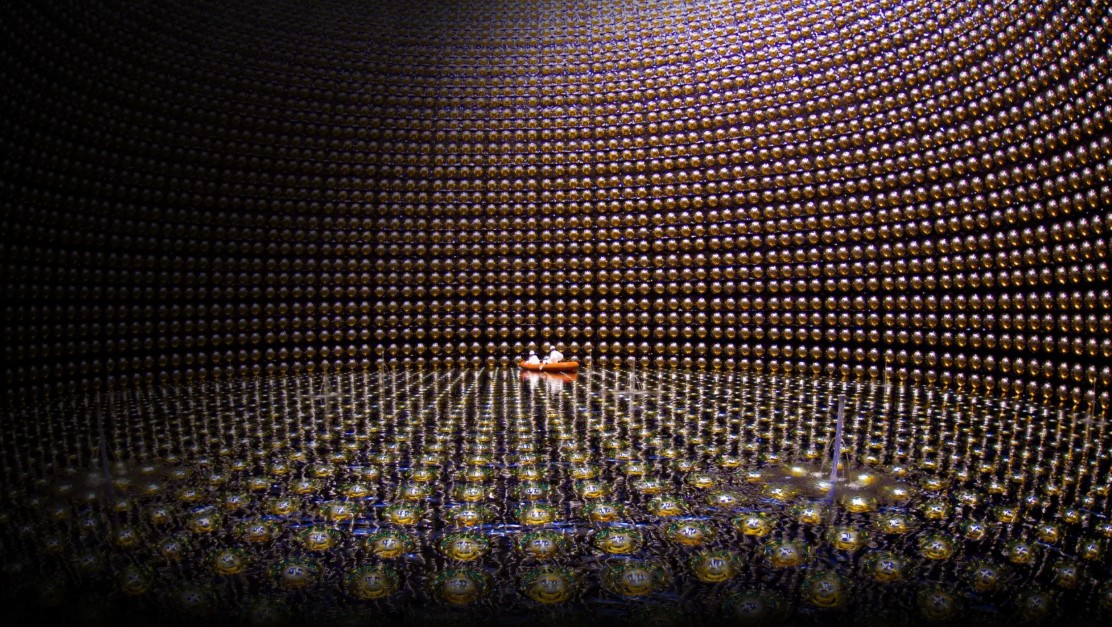
Neutrinos are among the most difficult particles to study. They have almost no mass, carry no electric charge, and can travel through Earth virtually undisturbed. Yet decades of increasingly ambitious experiments have transformed these elusive particles into valuable tools for understanding stars, galaxies, and fundamental physics, tells Quanta Magazine.
The neutrino was proposed by physicist Wolfgang Pauli in 1930 to explain missing energy in radioactive beta decay. In 1956, Clyde Cowan and Frederick Reines finally detected neutrinos using a 10-ton detector near a nuclear reactor in South Carolina. Scientists then turned their attention toward neutrinos produced inside the sun.
In the 1960s, Raymond Davis Jr. placed nearly 400,000 liters of chlorine-based cleaning fluid deep inside South Dakota’s Homestake mine. His experiment detected only about one-third of the solar neutrinos predicted by theory, creating the solar neutrino problem.
Later experiments solved the mystery. Japan’s Kamiokande and Super-Kamiokande detectors used enormous quantities of ultrapure water, while Canada’s Sudbury Neutrino Observatory relied on heavy water. Their findings showed that neutrinos can switch among three flavors: electron, muon, and tau. This oscillation also demonstrated that neutrinos have mass, something the Standard Model does not adequately explain.
Modern experiments are pushing neutrino science further. The IceCube Neutrino Observatory uses Antarctic ice to detect high-energy particles and has created a neutrino-based map of the Milky Way. KM3NeT, positioned deep in the Mediterranean Sea, has detected the highest-energy cosmic neutrino recorded so far.
China’s Jiangmen Underground Neutrino Observatory began operating in 2025 and has already produced exceptionally precise measurements of neutrino oscillations. Japan’s Hyper-Kamiokande and the U.S.-based Deep Underground Neutrino Experiment are expected to begin operating later this decade. Together, these massive detectors could help scientists determine neutrino masses, investigate matter-antimatter differences, and uncover physics beyond current theories.
