

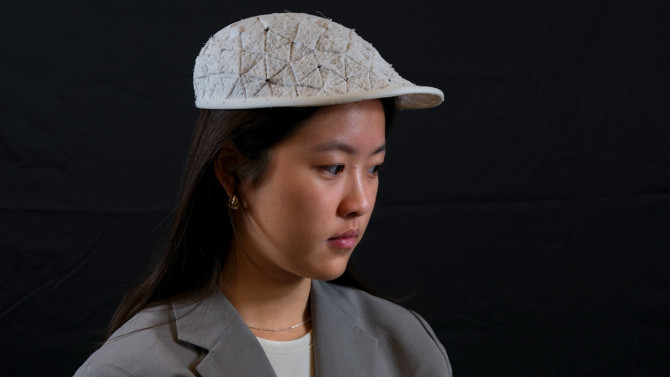
Researchers at Cornell’s Ann S. Bowers College of Computing and Information Science developed a system called OriStitch that turns flat fabric into detailed three-dimensional shapes using a combination of computation, laser cutting, and machine embroidery, tells Cornell Chronicle. The goal is to make complex textile folding faster and more accessible than traditional manual methods such as hand pleating and other machine-based workflows. OriStitch models a flat textile pattern from a simple 3D object and then uses programmed stitch placements to make the fabric fold itself when exposed to heat.
The core innovation lies in designing fully closed textile hinges. Each hinge consists of a pair of triangles sewn with heat-shrink polyester thread called chizimi. As the thread contracts during heat treatment, these hinges pull together and create the desired 3D surfaces. The software takes a 3D triangle mesh as input and maps it into a 2D configuration with a network of these functional hinges. This generates a fabrication plan appropriate for laser cutting fold lines and machine embroidery paths.
To fabricate a piece, a laser cutter first scores mountain and valley folds and trims excess material. An embroidery machine then stitches the pattern with both regular and heat-shrink threads. After soaking the piece to dissolve support stitches, heat treatment causes the active thread to shrink and pull the fabric into the target shape. In trials, OriStitch successfully converted 26 out of 28 test models from related research and produced prototypes such as a hat, a vase cover, and a handbag.
Unlike other computational textile workflows that require new fabrics or bespoke hardware, OriStitch works with off-the-shelf materials such as woven fabric, leather, felt, and composites. That compatibility could make the system immediately useful in fashion design, architecture, and smart textiles, including applications where sensors or electronics need to be embedded before the fabric changes shape.
The technology is not yet fully automated, since embroidery machines still need manual setup, but researchers aim to expand the capability to a wider range of materials and more complex designs.
